


On the hunt for repossessed houses for sale in Mandurah? It can feel a bit like searching for hidden treasure, and for good reason. These properties, often called mortgagee sales, can be a fantastic opportunity for sharp buyers to get into one of Western Australia's most loved coastal spots at a great price. But it's not like buying a regular home; you need to know what you're doing.
Unlocking the Potential of Mandurah Mortgagee Sales
Many people see a repossessed property and think "risk." But experienced investors and clued-in first-home buyers see something else entirely: a smart way into a hot market. Mandurah's property values have been climbing steadily, making it tough for some to get a foot in the door. Mortgagee sales can be the key that unlocks it. You just need to look past the myths and get familiar with how these deals work in WA.
So, what exactly is a repossessed home? In legal terms, it's a 'mortgagee-in-possession' sale. This happens when a homeowner can't keep up with their mortgage, and the lender (the mortgagee) steps in to sell the property and get their money back.
It’s not a fire sale, though. Lenders in Western Australia are legally required to get a fair market price. The crucial difference is that their main goal is to recover the debt quickly, not to squeeze every last dollar of profit out of the sale. This subtle shift in motivation is what can create a great deal for you.
Why Mandurah Is a Prime Location for These Opportunities
Mandurah isn't just a holiday town anymore. It's a thriving city with a growing population and a solid local economy. That classic coastal lifestyle, now backed by serious infrastructure investment, has sent property prices soaring. Sometimes, this rapid growth can put financial strain on homeowners, which unfortunately can lead to more mortgagee sales.
This creates a unique window for buyers who are ready to move. You're not dealing with a seller who’s emotionally attached or holding out for a dream price. You're dealing with a bank—a motivated institution that wants a clean, straightforward transaction.
For a prepared buyer, a mortgagee sale strips the emotion out of the negotiation. The bank isn't attached to the family memories in the home; they are focused on recovering their funds efficiently and meeting their legal obligations.
The Real Advantage for Buyers
The true value in chasing down repossessed houses for sale in Mandurah comes down to a few key things:
- Reduced Competition: These homes often need a bit more homework, which can scare off less experienced buyers. That means you’re not fighting against a massive crowd.
- Price Potential: While it’s never a guarantee, the bank’s need for a quick sale often means the final price can be lower than what a typical seller would accept.
- Transparency: The property is usually sold 'as-is, where-is.' That might sound intimidating, but it actually simplifies things. What you see is what you get, which forces you to do thorough inspections instead of getting bogged down in endless back-and-forth over minor fixes.
To navigate this niche successfully, you really need local expertise. An agent like David Beshay, who knows the Mandurah market inside and out and understands the unique process of a mortgagee sale, is a massive advantage. Having that expert guidance helps you find the right property, assess it properly, and buy with confidence, turning what could be a headache into a smart investment.
How Mortgagee Sales Work in Western Australia
To snag a great deal on a repossessed house in Mandurah, you've got to understand how the whole process works. This isn't your typical home sale, where a homeowner is in charge. A mortgagee sale is a completely different beast, driven by specific legal duties and financial pressures right here in Western Australia.
When a borrower can no longer keep up with their mortgage, the lender (the mortgagee) has the right to take possession of the property to get their money back. This is what we call a mortgagee-in-possession sale.
It’s a common myth that these are just desperate fire sales where banks will snap up any lowball offer. That’s not quite how it works.
The reality is, the lender has a legal duty of care to the original homeowner. They’re required to act in good faith and do what's reasonable to get a fair market price for the home at the time it’s sold. This is a crucial protection, stopping the borrower from being completely ripped off and shielding the bank from legal trouble later on.
Understanding the Lender's Motivation
Here's the key difference: a bank isn't trying to make a massive profit. Their main goal is simply to recover the outstanding loan amount, plus any legal fees and selling costs, and to do it as quickly and cleanly as possible.
A regular seller might hold out for their dream price or get emotional during negotiations. A bank, on the other hand, operates purely on financial logic and a strict legal framework.
This sets up a unique situation for buyers. The process is often more straightforward and less emotional, but it's also far less flexible. For instance, nearly all mortgagee properties are sold in 'as-is, where-is' condition.
A critical point for any buyer to remember is that the "as-is" clause is set in stone. The lender won't be fixing that leaky tap, patching a hole in the wall, or offering any guarantees about the appliances. What you see is exactly what you get.
This is because the bank has never lived there. They have no real knowledge of the property's history or any hidden problems. The responsibility to find any issues—be they structural, pest-related, or legal—falls entirely on your shoulders.
A Real-World Scenario
Let's picture this: a family in a Mandurah suburb hits a rough patch and falls behind on their mortgage. After trying to resolve the debt over a set period, the bank eventually has to step in and start the legal process to take possession of the house.
Once they're in control, the bank follows a pretty standard procedure:
- Secure the Property: The first thing they do is change the locks and make sure the home is secure.
- Get a Valuation: An independent valuation is ordered to set a realistic market price.
- Marketing the Home: They'll then hire a real estate agent to list the property and market it publicly, aiming to get competitive offers.
The property is then advertised as a 'mortgagee sale'. Knowing this background is vital. It explains why negotiations aren't about endless back-and-forth haggling. It's more about presenting a strong, clean offer with your financing already sorted. The lender wants certainty and a hassle-free settlement. You can get a deeper understanding of what a mortgagee sale is in our detailed guide.
The strong local market adds another layer to this. Mandurah's property market has been booming, with the median house price hitting $575,000—that's a massive annual growth of 21.1%. With the median monthly mortgage repayment at $1,486, rising interest rates have put a squeeze on some homeowners, which unfortunately can lead to more of these sales. You can check out more stats on Mandurah's market over at REIWA.
Key Differences: Traditional Sale vs. Mortgagee Sale
To really understand the landscape, it's helpful to see the two types of sales side-by-side. While both end with you getting the keys, the journey to get there can be wildly different. This table breaks down the main points you need to be aware of.
| Feature | Traditional Property Sale | Mortgagee (Repossessed) Sale |
|---|---|---|
| Seller's Motivation | Often emotional; aiming for the highest possible profit. | Purely financial; focused on recovering the outstanding debt. |
| Property Condition | Usually presented well. Seller may fix minor issues. | Sold "as-is, where-is." No repairs or warranties are provided. |
| Negotiation Style | Can be flexible, with back-and-forth offers and counteroffers. | More rigid. Lenders prefer clean, unconditional offers. |
| Disclosure | Seller must disclose known defects (e.g., structural issues). | Lender has limited knowledge; buyer bears full due diligence risk. |
| Settlement Terms | Often negotiable (e.g., settlement date, special conditions). | Less flexible. Lenders prefer standard, quick settlement terms. |
| Emotional Factor | High for both buyer and seller. | Low. It's a business transaction for the lender. |
| Risk to Buyer | Lower, as there's more information and potential for recourse. | Higher. The buyer is responsible for uncovering all potential issues. |
Ultimately, a mortgagee sale strips away the emotion and turns the transaction into a pure business deal. For the well-prepared buyer, this can be a fantastic opportunity, but it's crucial to go in with your eyes wide open to the risks involved.
Where to Find Repossessed Properties in Mandurah
Finding repossessed houses for sale in Mandurah isn't quite like your typical property hunt. You won't often see them advertised with big, flashy signs. These opportunities tend to fly under the radar, requiring a more hands-on approach from you as a buyer.
The key is knowing exactly where to look and who to speak to. While you might get lucky and spot a "mortgagee-in-possession" listing on a major real estate portal, the buyers who snap up the best deals are the ones who dig a little deeper.

Partnering With a Local Real Estate Agent
Honestly, your biggest advantage in this search is a well-connected local agent. Professionals like David Beshay who live and breathe the Mandurah market often get the inside scoop on distressed sales long before they hit the public domain. Lenders prefer working with trusted agents to handle these sales quickly and without fuss.
An experienced agent gives you two massive advantages:
- Early Access: They’re often the first to know about properties about to be listed as a mortgagee sale, giving you a crucial head start.
- Expert Guidance: They get the unique quirks of these transactions and can walk you through everything, from the first viewing to putting in a solid offer.
This network is invaluable. Picture this: an agent gets a call from a bank about a three-bedroom house in Halls Head that needs to be sold, fast. Before it's even photographed for an online listing, they can tip off their list of interested buyers. That gives you a chance to get your finances and due diligence sorted without fighting off a crowd.
Monitoring Bank and Lender Websites
Another smart move is to go straight to the source. Most of Australia’s big banks and some non-bank lenders have dedicated sections on their websites for mortgagee-in-possession properties. It’s often the first place these homes are officially advertised.
This method takes a bit more legwork—you'll need to check multiple sites regularly—but it can pay off. The information is coming directly from the seller, so it's reliable. Just remember to look beyond the big four banks; smaller lenders and credit unions operating in Western Australia are also worth checking.
Using Real Estate Portals Effectively
Even though not all repossessed homes are flagged, you can still use the major real estate portals to your advantage. The trick is to think beyond a simple suburb search. You need to use specific keywords in the search bar.
Try searching for terms like:
- "Mortgagee sale"
- "Bank owned"
- "Repossessed"
- "Must be sold"
- "Under instructions from"
Set up email alerts for these keywords in your target Mandurah suburbs (like Falcon, Wannanup, or Greenfields). This automates the hunt, ensuring you get a notification the second a relevant property goes live.
A common mistake is just searching for "repossessed houses for sale Mandurah." Agents often use more subtle wording in their listings to avoid any negative stigma, so broadening your keyword search is essential to uncover these hidden gems.
Keeping an Eye on Auction Announcements
A lot of repossessed properties end up going to auction. Lenders often favour this route because it's transparent, has a clear deadline, and creates a competitive setting that helps them achieve a fair market price, which they are legally required to do.
To stay in the loop, regularly check the auction schedules on real estate websites and in local papers. Look for properties being marketed with a sense of urgency. The agent will usually make it clear that the property will be sold on auction day. It's a great idea to attend a few auctions first—even if you're not bidding—just to get a feel for the pace and process.
Exploring Specialised Listing Platforms
Finally, there are a handful of specialised websites that focus only on tracking distressed, foreclosed, and mortgagee properties across Australia. These platforms pull listings from various sources—banks, agents, public records—and gather them all in one place.
Some of these services might require a subscription, but they can save you a huge amount of time. They often provide extra details about the property's history that you might not find elsewhere, giving you a clearer picture before you commit to investigating further. Combining these tools with the local knowledge of an agent like David Beshay gives you a powerful, multi-pronged strategy to find and secure a fantastic repossessed property in Mandurah.
Your Essential Due Diligence Checklist
When you start looking at repossessed houses for sale in Mandurah, you’ll quickly come across the phrase "as-is, where-is." This isn't just some casual real estate jargon; it’s a legally binding condition that puts all the responsibility for finding problems squarely on you, the buyer.
Unlike a standard sale where the seller has to disclose issues they know about, the bank has probably never even set foot inside the property. They offer no guarantees or warranties. This is why your due diligence isn't just a box-ticking exercise—it’s your single most important line of defence against buying a financial headache. Trust me, skipping these steps is a gamble you can't afford to take.
Non-Negotiable Building and Pest Inspections
First things first: get a professional building and pest inspection. I know it feels like an extra upfront cost, but it's nothing compared to the tens of thousands you could be on the hook for later. A qualified inspector is trained to see things the average person would walk right past.
These reports can uncover a whole host of deal-breaking issues:
- Structural Defects: Think major foundation cracks, signs the ground is shifting (subsidence), or a compromised roof frame. These are often the most expensive problems to fix.
- Termite Damage: It's no secret that Western Australia is a high-risk zone for termites. An infestation can cause devastating damage that isn't always obvious to the naked eye.
- Water Damage and Mould: Leaky roofs, bad drainage, or old plumbing can lead to hidden mould and wood rot, which are not only costly to repair but can also be serious health hazards.
- Unauthorised Additions: An experienced inspector can usually spot extensions or modifications that look like they might not have council approval. If they don't, that problem becomes yours to sort out.
A detailed report gives you the full story of the property's health. It gives you the power to either walk away from a potential money pit or go in with your eyes wide open, fully aware of the repair costs you're facing.
Uncovering Hidden Liabilities with a Title Search
Beyond the physical bricks and mortar, you need to dig into the property’s legal standing. A Certificate of Title search is an absolute must for anyone considering repossessed houses for sale in Mandurah. This search, done through Landgate here in WA, confirms who the legal owner is and, more importantly, reveals any encumbrances registered against the property.
An encumbrance is essentially a claim or liability attached to the land that could complicate your ownership. Imagine you find a promising property in Greenfields. You're ready to make an offer, but your title search uncovers a caveat lodged by a builder who was never paid for a renovation.
This caveat acts like a legal handbrake, stopping the sale from going ahead until that dispute is sorted out. Without that title search, you could have already paid a deposit and forked out for inspections, only to find the whole deal is dead in the water because of a legal issue you knew nothing about.
It's also worth doing a Personal Property Securities Register (PPSR) search. It's less common for the property itself, but it checks for debts on items that might be included, like financed solar panels or water tanks. To get a better handle on all this, check out our detailed guide explaining what is due diligence in real estate.
Researching Council Zoning and Sales History
Your homework doesn't stop at the property's boundary line. You've got to understand the bigger picture of the neighbourhood you're buying into.
Give the City of Mandurah a call and check the property's zoning. This tells you what you can—and can't—do with the land. Is it strictly residential, or could a shopping complex pop up next door one day? Are there any upcoming council plans or overlays for the area that could affect the property’s future value?
Finally, arm yourself with cold, hard data. Look up the property's sales history and compare it to recent sales of similar homes in the same suburb. This market analysis is what allows you to make a confident, evidence-based offer. Knowing what comparable properties have sold for is your best tool to avoid overpaying, especially in the heat of an auction. This is where getting a free appraisal from a local expert becomes invaluable, giving you the precise market context you need to negotiate effectively.
Financing and Finalizing Your Purchase
You've done the legwork—scouting potential repossessed houses in Mandurah and completing your due diligence. Now comes the moment of truth: securing the property. At this stage, a rock-solid financial strategy isn't just a nice-to-have; it's absolutely essential. With mortgagee sales, lenders crave certainty above all else, making your preparation here the difference between success and disappointment.
Forget what you know about standard property deals with flexible finance clauses. Repossessed sales are a different beast entirely. They are far more rigid, and whether you're submitting a private offer or heading to auction, having your finances locked and loaded is non-negotiable.
The Power of Mortgage Pre-Approval
Before you even dream of making an offer, getting mortgage pre-approval is your first and most critical move. I'm not talking about a quick estimate from an online calculator. This needs to be a formal confirmation from a lender stating they are willing to lend you a specific amount, pending a property valuation.
For a mortgagee sale, pre-approval is your ticket to being taken seriously. It proves you're a capable buyer ready to move. The banks managing these sales are often sifting through multiple offers, and they will always gravitate towards the one with the least risk and the fastest path to settlement. An offer without pre-approval is almost guaranteed to be overlooked.
This is doubly true for auctions. When that hammer falls, the sale is final and unconditional. There's no backing out because your loan didn't come through. You absolutely must know your exact borrowing capacity before you even raise your hand.
Bidding at Auction Versus Private Treaty Offers
Your approach to buying will hinge on whether the property is up for auction or being sold via private treaty. Each demands a unique strategy.
- Auction Strategy: Know your walk-away price and stick to it religiously. Auction fever is a real phenomenon; the adrenaline and competitive environment can easily trick you into bidding beyond your budget. Remember, the bank is legally obligated to get a fair market price, so don't go in expecting a once-in-a-lifetime steal.
- Private Treaty Offer: When you're making an offer on a repossessed house via private treaty, keep it clean and strong. That means minimal conditions, a standard settlement date, and attaching your proof of finance. A bank will often favour a slightly lower, unconditional offer over a higher one tied up with "subject to" clauses.
The strongest offer isn't always the highest dollar amount. Lenders prioritise certainty. A clean, pre-approved offer that meets their reserve is often the winning ticket because it promises a swift, uncomplicated settlement.
Navigating Western Australia Specifics
Once your offer is accepted, the final steps involve a few WA-specific hurdles you'll need to clear.
The process below highlights the key checkpoints—inspection, legal searches, and valuation—that all feed into your final offer and financial planning.
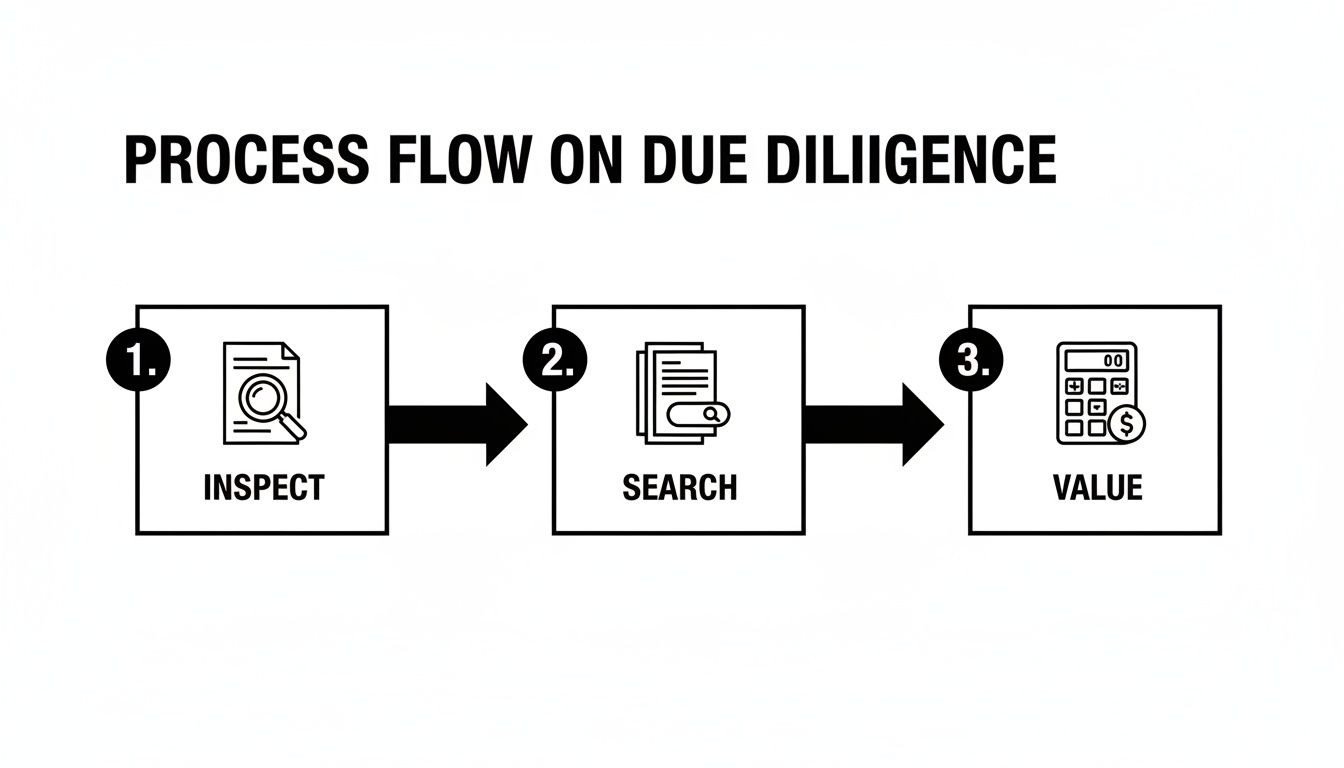
Running through these steps ensures you have a crystal-clear picture of the property's physical and legal health before you financially commit, which is vital in an 'as-is' transaction.
Stamp Duty in WA
Don't forget stamp duty (or transfer duty). It's a significant cost that must be factored into your budget. In Western Australia, this state tax is based on the dutiable value of the property. For a home at Mandurah’s median of $575,000, you could be looking at an extra $21,000 in stamp duty.
Settlement Timelines
Lenders managing sales prefer standard settlement periods, usually 30 to 45 days. Unlike private sellers, they rarely entertain negotiations for longer or more complex terms. Get a conveyancer or settlement agent on your team who has experience with mortgagee sales to ensure this process goes off without a hitch.
The Mandurah property scene is always moving, with around 424 houses currently for sale. Broader economic shifts in WA have seen mortgage stress affect about 1 in 12 regional households, which can sometimes increase the supply of repossessed homes. These properties might sell at auction for 15-25% below market value, creating a huge opportunity for buyers who are ready to act. You can get a feel for Mandurah's active property market right now.
Common Pitfalls to Avoid
Even the most prepared buyers can slip up. Watch out for these common traps:
- Underestimating Renovation Costs: 'As-is' often means 'needs work'. Get detailed quotes before you commit and always add a 15-20% contingency to your reno budget for those nasty surprises.
- Forgetting Additional Costs: The final price is more than just the number on the contract. You need to budget for stamp duty, legal fees, inspection costs, and potential holding costs if the property is vacant.
- Getting Emotionally Attached: This is a business deal, plain and simple. If the numbers don't stack up or the bidding gets out of hand, you must be prepared to walk away.
Successfully buying a repossessed house boils down to a logical, disciplined approach. With solid financial backing and a clear head, you can turn these unique market opportunities into a genuinely rewarding investment.
Partner With a Local Expert to Secure Your Deal
Trying to tackle the market for repossessed houses for sale in Mandurah on your own can feel like a mammoth task. As we’ve covered, it’s a high-stakes environment where success hinges on much more than just spotting a listing online. The whole process is packed with unique challenges, from uncovering those hidden, off-market properties to performing exhaustive due diligence under a ticking clock.
This is exactly where having a professional in your corner becomes your most valuable asset.
A specialist doesn’t just send you listings; they give you the strategic edge you need to lock in a genuinely great deal while steering you clear of potentially costly mistakes. Their deep-seated local knowledge and established relationships are, frankly, invaluable.
The Value of Specialised Guidance
Working with a dedicated expert like David Beshay completely changes the game. Instead of just crossing your fingers and hoping for the best, you move forward with a clear, confident strategy that’s built on years of hands-on experience.
You’ll find the key advantages are pretty clear:
- Insider Access: Getting a look-in on off-market deals and mortgagee sales well before they hit the mainstream advertising channels.
- Negotiation Power: Using proven skills to put together compelling, clean offers that banks and lenders tend to favour.
- Risk Mitigation: Making sure every single inspection, title search, and legal check is handled meticulously to protect your interests.
At the end of the day, buying a repossessed home is a significant investment. Partnering with a professional ensures you’re not just buying a property—you're making a sound financial decision.
If you're ready to learn more about how a specialist can help you, take a look at our article on what a buyer’s agent is and how they can help.
Common Questions About Buying Repossessed Homes
When you start looking into repossessed houses for sale in Mandurah, you quickly realise it’s a unique corner of the property market. It's only natural to have a few questions. Let's tackle some of the most common ones that come up.
Are Repossessed Homes Always Cheaper?
This is the big one, isn't it? The short answer is: not always, but often. A bank's main goal is simply to get its money back, not squeeze every last dollar out of the sale like a regular homeowner might. They have a duty to get a fair market price, but the need for a quick, guaranteed sale can often lead to a deal below what similar properties are going for.
But here’s the catch. These homes are sold "as-is." That means every single repair, from a leaky tap to a major structural issue, lands squarely on your shoulders. A property that looks like a steal on paper could easily cost you more than a standard home once you add up the renovation bills.
The true value lies in the final, all-in cost, not just the sticker price.
Can I Negotiate on the Price?
Absolutely, but it’s a different ball game. Forget the emotional back-and-forth you might have with a private seller. When you’re negotiating with a bank, it’s all about logic and certainty.
Lenders want a clean, simple, and reliable transaction. A strong, unconditional offer with your finance locked and loaded is far more attractive than a slightly higher offer that’s full of conditions. Your best negotiating tool is being a prepared, serious buyer who can promise a hassle-free settlement.
Here's a tip from experience: An offer that is $5,000 lower but has no finance clause is often more appealing to a lender than a higher conditional offer. For them, certainty is king.
What Are the Biggest Risks Involved?
The number one risk when buying repossessed houses in Mandurah is the unknown. You're buying the property "as-is," which means you inherit all its problems—the ones you can see and, more importantly, the ones you can't. The bank has never lived there and won't give you any history on the property's condition.
This is why your due diligence is non-negotiable. The biggest risks usually fall into a few categories:
- Hidden Structural Defects: Things like foundation issues or termite damage that can cost a fortune to fix.
- Legal Encumbrances: Unexpected claims or caveats on the property title that could derail the sale.
- Poor Condition: The home may have been neglected for a long time or even deliberately damaged by the previous occupants on their way out.
Think of building, pest, and legal checks not as optional extras, but as essential armour protecting you from what could be a massive financial hit.
Navigating the world of mortgagee sales takes more than just a keen eye—it requires local expertise and a solid strategy. At David Beshay Real Estate, we bring the in-depth market knowledge and sharp negotiation skills you need to find and secure these unique opportunities in Mandurah. Connect with us today for a no-obligation chat to get your property journey started.

