


At its heart, vendor finance is a pretty simple idea. Instead of a buyer heading to the bank for a mortgage, the seller provides the financing themselves. It's often called seller financing, and it lets the buyer pay off the purchase price over time through an instalment plan we all agree on, usually with a bit of interest.
Unpacking the Basics of Vendor Finance
Think of it as a strategic, 'seller-funded' loan that helps get a deal over the line. It's a fantastic tool that can open doors for buyers who might find it tough to get a traditional bank loan, maybe because of strict lending rules or not having a massive deposit saved up.
For sellers, it's a great way to bring in a much wider pool of potential buyers. This can often lead to a faster sale and sometimes even a better price. It's a flexible approach that creates a win-win when the circumstances are right.
This alternative way of funding a purchase relies on a few key things that both buyer and seller need to hash out and agree upon. While you can tailor the specifics to suit the deal, most arrangements follow a similar structure.
The Key Players and Their Roles
At its core, a vendor finance agreement is a partnership built on a few essential components. Let's break down who does what.
- The Vendor (Seller): This is you, the current owner of the business or property. Instead of getting a lump sum payment on settlement day, you agree to receive it in instalments over time, effectively becoming the lender.
- The Purchaser (Buyer): This is the person or company wanting to buy your asset but using your financing instead of a bank's. Their main job is to make the regular payments exactly as laid out in the agreement.
- The Loan Agreement: This is the most critical piece of paper in the whole deal. It’s the legal document that spells out every single term: the total purchase price, the deposit, how long the buyer has to pay it all back (the loan term), the interest rate, and the repayment schedule.
To give you a clearer picture, here’s a quick summary of how these pieces fit together.
Vendor Finance At A Glance
| Component | Description |
|---|---|
| The Vendor (Seller) | Acts as the lender, providing the finance for the purchase. |
| The Purchaser (Buyer) | Borrows from the seller and makes regular repayments. |
| The Asset | The business or property being sold. |
| Deposit | An initial upfront payment made by the buyer to the seller. |
| Loan Amount | The remaining purchase price after the deposit is paid. |
| Loan Term | The agreed-upon timeframe for the buyer to repay the loan. |
| Interest Rate | The percentage charged on the outstanding loan amount. |
| Loan Agreement | The legally binding contract detailing all terms and conditions. |
This entire structure is formalised in legal documents designed to protect both you and the buyer. Just like any standard property deal, a successful vendor finance arrangement relies on crystal-clear documentation. To get a better handle on the foundational legal paperwork involved in sales, it's worth understanding what is a contract of sale and why it’s so vital for any purchase. Getting these details right from the very beginning is what makes the whole thing work.
How a Vendor Finance Deal Is Structured
So, what does a vendor finance deal actually look like in the real world? Let's move past the theory and walk through how these arrangements are put together, piece by piece.
Every deal kicks off with a negotiation. This is where the buyer and seller sit down to hash out the core components of the sale. It’s far more than just shaking hands on a price; it’s about building a workable financial partnership that will last for the entire loan term.
Key Terms to Negotiate
Before a single legal document is drafted, several key elements need to be clearly defined and agreed upon. Getting these right from the start protects both sides and prevents nasty surprises down the track.
- Purchase Price: The total agreed-upon value of the business or property.
- Deposit Amount: The initial lump sum the buyer pays upfront. This shows genuine commitment and lowers the seller's risk.
- Loan Term: The length of time the buyer has to repay the outstanding balance. This typically ranges from two to five years.
- Interest Rate: The percentage charged on the loan. It's usually a bit higher than standard bank rates, which compensates the seller for the extra risk they're shouldering.
A well-structured vendor finance deal hinges on clarity and mutual agreement. The terms negotiated upfront become the legally binding roadmap for the entire transaction, dictating payments, security, and obligations until the final dollar is paid.
A Practical Perth Example
Let's paint a picture. Imagine a small, successful logistics company in Perth is on the market for $600,000. A motivated buyer with solid industry experience wants to take it on, but they can only pull together a $120,000 deposit and can't get a traditional bank loan for the rest.
The seller is keen to retire and feels confident in the buyer’s ability to run the business. So, they agree to offer vendor finance for the remaining $480,000.
Here are the terms they settle on:
- Loan Term: 5 years (60 months)
- Interest Rate: 8% per annum
- Security: The seller places a charge over the business assets using a General Security Agreement (GSA). Put simply, this means if the buyer defaults on the loan, the seller can reclaim the assets to recover their money.
- Final Payment: The agreement includes a ‘balloon payment’ for the remaining principal at the end of the 5-year term. This structure keeps the monthly repayments more manageable for the buyer, who is expected to refinance with a bank once the business is more established.
This chart shows the basic flow of how it all works.
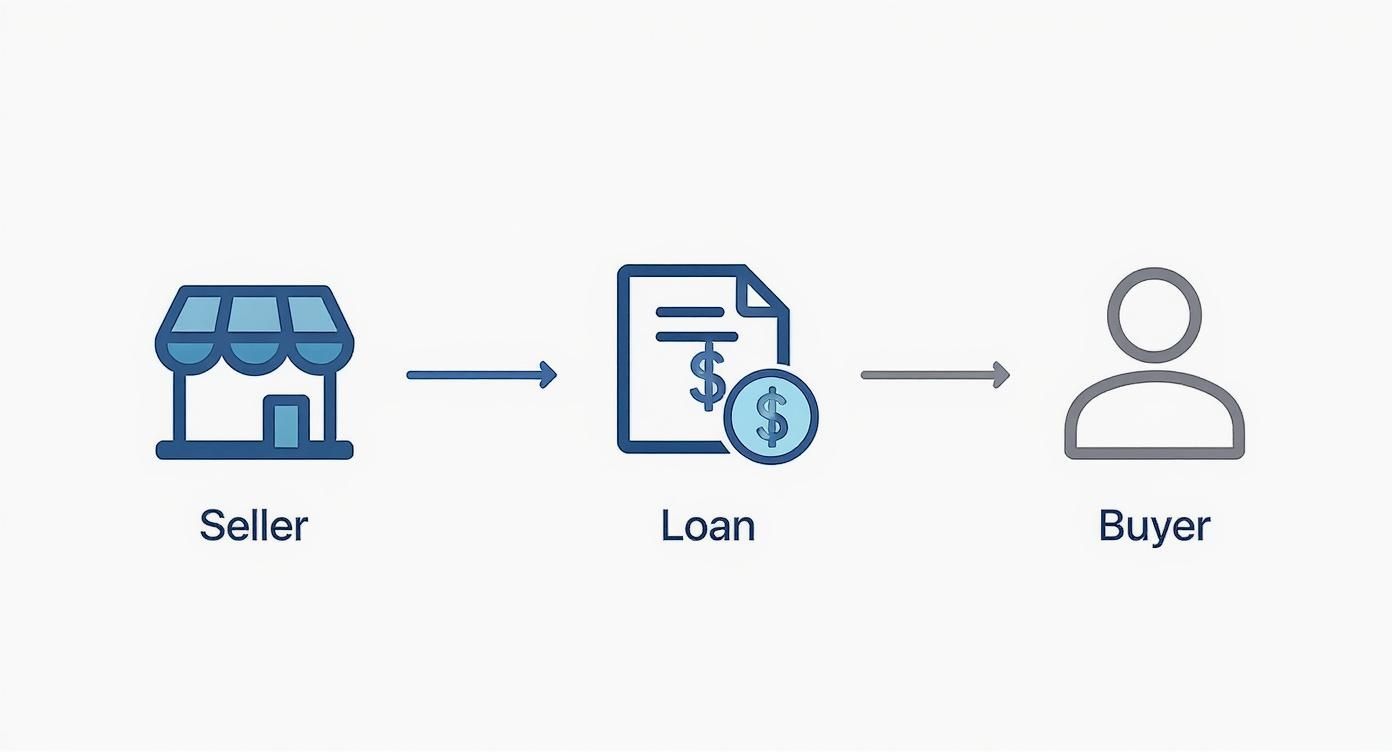
Essentially, the seller steps into the role of a lender, providing the loan directly to the buyer to make the sale happen.
The rise of alternative financing like this is part of a much bigger trend. The Australian trade finance market, which vendor finance is a part of, reached USD 1,082 million and is tipped to grow significantly. You can dig into the numbers in the IMARC Group's market analysis.
Understanding the security part of the deal is critical. By taking a charge over the assets, the seller is effectively setting a loan-to-value ratio for the transaction—a key concept in any type of financing. You can explore our guide on what is loan-to-value ratio to get a better handle on how lenders assess risk. This setup gives the seller a safety net while allowing the buyer to move forward with the purchase.
Weighing the Benefits and Risks for Each Party

Vendor finance can look like the perfect answer to a tricky sales problem, but it's a path with its own unique set of advantages and potential traps for both sides of the deal. Getting a firm grip on this balance is non-negotiable before you commit.
For sellers, it's about weighing up a potentially better sale against the very real risks of becoming a lender. For buyers, it’s about gaining access to an opportunity that might otherwise be out of reach, versus potentially paying more for it in the long run. This isn’t a one-size-fits-all solution; it's a strategic move. A clear-eyed view of what each party gains and risks is the first step toward a successful outcome.
The Seller's Perspective
For the property or business owner, offering vendor finance can be a seriously powerful sales tool. It can massively widen the net of potential buyers, pulling in those who are highly capable but just don't tick the rigid boxes set by traditional banks. This increased demand often translates into a higher final sale price.
Another major benefit is the creation of an ongoing income stream. Instead of a single lump sum hitting your account, you receive regular payments plus interest over the loan term. This interest income can be a welcome financial buffer, turning a one-off transaction into a multi-year revenue source.
But let's be clear about the main risk: buyer default. If the purchaser stops making payments, the seller is left with the often costly and time-consuming headache of recovering the asset or the outstanding funds. This is the central trade-off: you accept delayed cash flow and default risk in exchange for a potentially faster, more profitable sale.
The Buyer's Perspective
For the buyer, vendor finance is often the key that unlocks a door that would otherwise remain firmly shut. Its greatest advantage is providing a direct path to ownership when traditional bank financing is off the table. This might be due to a lack of trading history for a new business or a deposit that falls just shy of a bank’s strict requirements.
The whole process is typically much quicker than dealing with a big financial institution. With fewer bureaucratic hoops to jump through, deals can be negotiated and finalised in a fraction of the time, letting the buyer take the reins of their new asset sooner. On top of that, buyers can often negotiate more flexible and customised terms directly with the seller, tailoring repayments to suit their projected cash flow.
The trade-off for this accessibility usually comes in the form of a higher interest rate compared to a standard bank loan. Sellers charge this premium to compensate for the significant risk they’re taking on. You'll also find that default clauses in vendor finance agreements are often much stricter, meaning the buyer could risk losing their deposit and the asset entirely if they miss payments.
Vendor finance creates a direct financial relationship where the seller's success is tied to the buyer's ability to thrive. This alignment of interests can foster a supportive partnership but requires absolute clarity and trust from both parties to navigate the inherent risks.
To make things clearer, this side-by-side table summarises the key points for everyone involved.
Vendor Finance Comparison For Sellers and Buyers
| Party | Pros (Advantages) | Cons (Disadvantages) |
|---|---|---|
| Seller | Can achieve a higher sale price. Attracts a wider pool of buyers. Earns ongoing interest income. | Delayed full payment (cash flow impact). Risk of buyer default and non-payment. Potential legal costs for recovery. |
| Buyer | Overcomes traditional financing barriers. Faster and more straightforward sale process. More flexible and negotiable loan terms. | Often comes with higher interest rates. Stricter default conditions and penalties. May require a larger initial deposit. |
Deciding whether to offer or accept vendor finance requires careful thought. For sellers, it shares some principles with selling property privately, where you take on more direct responsibility for the outcome. For both parties, a thorough evaluation of these pros and cons is crucial to ensure the arrangement truly aligns with their financial goals and risk tolerance.
Navigating the Legal and Tax Essentials
When it comes to a vendor finance deal, getting the legal and financial structure right isn't just important—it's non-negotiable. While the concept itself is pretty straightforward, the execution needs meticulous attention to detail. This is to make sure everything is compliant, enforceable, and protects both you and the buyer.
A handshake agreement simply won’t cut it here. Robust legal documentation is your best defence.
For businesses in Australia, and especially here in Western Australia, two documents form the bedrock of any secure arrangement. The first is a carefully drafted formal loan agreement. This document needs to go well beyond the basics, detailing what happens in a default, remedies for late payments, and the responsibilities of each party in clear, unambiguous language.
The second is a General Security Agreement (GSA). Think of this as the seller’s safety net. A GSA gives you a security interest over the business assets being sold. Crucially, this agreement must be registered on the Personal Property Securities Register (PPSR) to make it legally enforceable against anyone else.
Protecting Your Interests with Professional Advice
Trying to navigate this process without an expert in your corner is a huge risk. You absolutely need to engage a legal professional who specialises in commercial transactions to draft and review all your documents. They will ensure your agreements comply with legislation like the National Consumer Credit Protection Act 2009 (if it applies) and that your security interest is correctly registered on the PPSR.
Without a properly registered GSA, a seller’s claim over the business assets could be worthless if the buyer becomes insolvent. Professional legal advice ensures your security is perfected, giving you the best possible protection if things go wrong.
A good lawyer will also help structure the deal to head off potential disputes before they even start, making sure every foreseeable scenario is covered in the contract. This upfront investment is tiny compared to the potential cost and headache of litigation down the track.
Understanding the Tax Implications
Beyond the legal paperwork, both the seller and the buyer have to get their heads around the tax consequences. These obligations are different for each party and must be managed correctly to stay on the right side of the Australian Taxation Office (ATO).
For Sellers:
- Capital Gains Tax (CGT): Selling the asset will almost certainly trigger a CGT event. You’ll need to calculate the capital gain or loss and declare it, though you might be eligible for certain concessions.
- Interest as Income: Any interest you receive from the buyer over the loan term must be declared as assessable income on your tax return.
For Buyers:
- Deductible Interest: The interest payments made to the seller are generally tax-deductible as a business expense.
- Asset Depreciation: The buyer can typically claim depreciation on the business assets they've purchased.
Structuring the deal properly from a tax perspective can unlock significant benefits, but getting it wrong can lead to some nasty and unexpected bills. This is why consulting with an accountant alongside your legal advisor is so important. This dual-pronged approach is the key to a successful—and profitable—vendor finance outcome.
Right, let's move past the theory. The best way to really get your head around vendor finance is to see how it plays out in the real world. A few stories from the trenches will show you just how flexible this funding tool can be across different Aussie business scenarios.
These aren't textbook examples; they show how deals get shaped around unique situations, proving vendor finance is much more than just a dry definition.
Case Study 1: The Fremantle Cafe Handover
Picture this: a beloved café owner in Fremantle is finally ready to hang up her apron and retire. Her long-serving manager, who knows the business inside and out, has always dreamed of taking over. The problem? He can't get the deposit together for a traditional bank loan.
Instead of selling to a stranger, the owner offers a vendor finance deal.
Here’s what the structure looks like:
- Purchase Price: $250,000
- Buyer's Deposit: $50,000 (what the manager could pull together)
- Vendor Finance Loan: $200,000, paid back over five years at a 7.5% interest rate.
For the owner, it's a win. She gets her full asking price and knows her legacy is in trusted hands. For the manager, it’s the opportunity of a lifetime. The best part? The transition is completely seamless for the staff and loyal customers.
Case Study 2: The Tech Startup Management Buyout
Now, let's head over to a growing tech startup in Perth. The original founders are ready to exit and cash in on their hard work. The current management team is the perfect group to take the reins, but they can't get the venture capital needed for a full buyout.
The solution? The founders agree to a vendor finance arrangement covering 30% of the company's valuation.
This gives the management team the control they need to keep driving the business forward. Meanwhile, the founders still have skin in the game, getting their money back (with interest) as the company they built continues to succeed. It’s a clever, strategic move that keeps the company’s growth on track without the disruption of an outside sale.
Vendor finance is the bridge that connects a seller who wants a fair price with a capable buyer who just can’t get traditional bank funding. It turns a potential dead-end into a deal that works for everyone.
The sheer versatility of vendor finance is why we're seeing it pop up more and more. In Australia, it’s being used across all sorts of industries—manufacturing, healthcare, IT, construction, and retail. Market reports are pointing to strong growth in this area, driven by a real need for more flexible funding options. If you want to dive deeper into the numbers, you can check out the latest vendor finance market analysis.
Case Study 3: The Manufacturing Division Sale
Let's look at a bigger player. A large manufacturing firm here in WA decides to sell off a non-core division to sharpen its focus. A smaller, more agile competitor sees a golden opportunity to grab market share, but the full acquisition price is just a bit too steep.
To get the deal over the line, the seller offers partial vendor finance specifically for the equipment and inventory.
This lets the big firm offload the division quickly and cleanly. At the same time, the smaller competitor can absorb the new operation without having to over-leverage itself with the bank. It's a pragmatic solution that benefits both sides.
So, you're considering vendor finance. Fantastic. Whether you're a seller thinking of offering it or a buyer looking for a more flexible way into a business, the key is to approach it with a clear head and a solid plan. Jumping in without doing your homework is a recipe for disaster.
First things first: due diligence. This isn't just kicking the tyres; it's a deep dive. For buyers, that means getting forensic with the business's financials, its daily operations, and where it sits in the market. For sellers, you need to be just as tough. You're essentially becoming the bank, so you must scrutinise the buyer's business sense, their credit history, and whether their plans for your old business actually stack up. This isn't about gut feelings; it's about cold, hard facts.
Building Your Action Plan
Once the initial checks are done and you're both still interested, it's time to get down to brass tacks. Think of this checklist as your roadmap for structuring a deal that works for everyone.
- Assess the Financial Forecasts: A buyer needs to show their workings. Realistic cash flow projections are a must—they need to prove they can comfortably make the repayments. Sellers, you need to poke holes in these forecasts. Test them, question them, and be sure you understand the level of risk you’re taking on.
- Get the Pros Involved: This one is absolutely non-negotiable. Both of you need your own independent legal and accounting experts who have experience with vendor finance. They’ll spot the red flags and hidden risks you might miss.
- Prepare to Negotiate: Walk into the negotiation knowing your ideal terms—the interest rate, loan term, deposit, and what security you'll require. But just as importantly, know where you’re willing to bend. A good deal requires a bit of give and take.
A well-prepared vendor finance agreement is more than just a contract; it's a blueprint for a successful partnership. It plans for the 'what-ifs' from the very beginning, ensuring both sides are protected long after the ink is dry.
You'll need specialised legal help to draft the loan agreement and handle things like security registrations on the PPSR. In Australia, vendor finance has become a real lifeline for SMEs that can't get a look-in with traditional banks, which makes having a rock-solid legal framework more critical than ever. You can read more about the growth of business financing in Australia to see just how common this is becoming. Proper professional guidance ensures your paperwork isn't just compliant—it's actually enforceable if things go sideways.
Navigating the complexities of property and business sales requires a steady, experienced hand. At David Beshay Real Estate, we provide the specialised knowledge needed to structure deals that protect your interests and achieve your goals. Contact us today for a confidential discussion about your options.

