


When you're diving into the world of property, you'll hear a lot of acronyms thrown around. One of the most important is LVR, or Loan-to-Value Ratio. So, what exactly is it?
Think of it as the bank's quick snapshot of your financial commitment to a property. It's a simple percentage that shows how much of the property's value you're borrowing compared to how much you're putting in yourself.
A lower LVR is great news. It means you’ve saved a bigger deposit, and lenders see you as a safer bet. On the flip side, a higher LVR tells them they're taking on more of the risk.
Your Quick Guide to Loan-to-Value Ratio

Let's break it down with an analogy. Picture a see-saw. On one end, you have the loan amount the bank is giving you. On the other, you have the property's market value. A healthy, balanced see-saw—where your deposit is substantial—makes lenders feel secure and confident in your application.
When you have a low LVR, it proves you've got significant "skin in the game." This makes you a much more attractive applicant because it reduces the lender's potential loss if, for whatever reason, you couldn't make your repayments down the track. In many ways, this single number is the gatekeeper to the best home loan products on the market.
The LVR Landscape in Australia
Across Australia, LVRs can look quite different depending on who is buying and why. Recent data, for instance, shows a clear split between first-time buyers and those refinancing.
People buying new homes are borrowing, on average, 75% of their property's value. But for those refinancing an existing mortgage, that number drops to a much lower average of 52%. It’s a perfect illustration of how building equity over time naturally improves a homeowner's LVR. You can explore more home loan statistics to see these trends for yourself.
This percentage is so much more than just a figure on a form. It has a direct impact on your mortgage application, the interest rate you'll be offered, and the total cost of your loan over its lifetime. Getting your head around your LVR is the first real step toward a successful property purchase, whether here in Mandurah or anywhere else.
A strong LVR isn’t just about getting your loan approved. It's your ticket to unlocking better interest rates, dodging expensive fees like Lenders' Mortgage Insurance (LMI), and giving you more power when you negotiate with the banks.
Ultimately, knowing how to manage your LVR gives you far more control over your financial future as a homeowner.
LVR Quick Reference: The Key Takeaways
To make it even clearer, here’s a simple table that breaks down what different LVR brackets mean for both you and the lender.
| LVR Bracket | What It Means for Lenders | What It Means for Borrowers |
|---|---|---|
| 80% or Lower | Low Risk. This is the sweet spot. They see a borrower with a solid deposit and a strong commitment. | High Chance of Approval. You're likely to get access to the best interest rates and avoid paying for LMI. |
| 81% – 90% | Moderate Risk. Lenders are still very interested but will likely require you to pay for Lenders' Mortgage Insurance (LMI). | Good Chance of Approval. You'll need LMI, which adds to your costs, but you can still secure a competitive loan. |
| 90% or Higher | High Risk. Only some specialised lenders will consider this. The loan conditions will be much stricter. | Tougher to Get Approved. Expect higher interest rates and significant LMI costs. This is often an option for first-home buyers using government schemes. |
Understanding these tiers helps you see exactly where you stand and what you need to aim for to put yourself in the strongest possible position.
How to Calculate Your Loan to Value Ratio

Figuring out your Loan to Value Ratio (which we call LVR in the industry) is refreshingly simple. Don't worry, there’s no complex algebra here—just a straightforward formula that gives you and the lender a crystal-clear picture of where you stand.
It all boils down to this:
LVR (%) = (Loan Amount ÷ Property Value) x 100
Let’s run through a real-world scenario. Imagine you’re a first-home buyer in Mandurah and you’ve found the perfect spot for $500,000. You’ve been saving hard and have a $100,000 deposit ready to go.
First, you work out the loan amount by subtracting your deposit from the property’s price: $500,000 – $100,000 = $400,000.
Now, we just plug those numbers into our LVR formula:
- Loan Amount: $400,000
- Property Value: $500,000
($400,000 ÷ $500,000) x 100 = 80% LVR
An 80% LVR is the gold standard for most lenders. It shows them you have a solid 20% deposit, which signals good financial discipline and significantly lowers their risk.
Comparing Different Scenarios
So, what happens if the deposit is smaller? Let’s look at an investor eyeing an apartment in Sydney valued at $800,000. They’ve got a 10% deposit, which works out to $80,000.
This means they’ll need to borrow the remaining $720,000 ($800,000 – $80,000).
Let’s calculate their LVR:
($720,000 ÷ $800,000) x 100 = 90% LVR
While a loan with a 90% LVR is certainly possible, it puts the borrower into a higher-risk category from the bank's perspective. This nearly always means they'll have to pay for Lenders' Mortgage Insurance (LMI) and might even face slightly higher interest rates than someone with that magic 80% LVR.
Key Takeaway: The single most important part of this calculation is the 'Property Value'. Lenders don't just take your word for it; they use the figure from their own independent bank valuation.
A Common Pitfall to Avoid
One of the most frequent mistakes borrowers make is assuming the purchase price and the bank's official valuation will be the same number. They often aren't.
Let's say you agree to buy a home for $650,000, but the bank sends out their valuer who determines it’s only worth $630,000. The bank will base your LVR on their lower figure, not what you offered.
This little discrepancy can suddenly push your LVR higher than you planned, which could impact your loan approval or force you to scramble for extra cash to make up the difference in your deposit. It’s worth taking the time to understand what is property valuation to get a better handle on how lenders determine a property's true worth.
By calculating your LVR accurately and keeping the valuation process in mind, you can walk into your home loan application with clarity and a whole lot more confidence.
Why Lenders See LVR as a Critical Risk Signal
When you apply for a home loan, your Loan to Value Ratio (LVR) isn’t just another number on a form. For a lender, it’s the single most important signal they have to measure their risk.
Put yourself in their shoes for a moment. They’re about to invest a huge sum of money into your property, and they need to know their investment is secure. A low LVR is their green light.
When you front up with a substantial deposit, it shows you have significant "skin in the game." This financial commitment immediately tells the lender you’re a serious, disciplined borrower who is far less likely to default. A larger deposit also creates a crucial buffer for the bank. If property values were to dip, your equity acts as a cushion, absorbing the initial loss and protecting the lender's capital.
High LVR: The Lender's Red Flag
On the flip side, a high LVR—typically anything above 80%—sets off alarm bells. It signals that you’re borrowing almost the entire value of the property, leaving very little room for error. Lenders view this as a much riskier proposition for a few key reasons:
- Less Borrower Commitment: A small deposit can sometimes be seen as a lower level of financial buy-in from the borrower.
- Vulnerability to Market Shifts: If property prices fall, a borrower with a high LVR could quickly find themselves in negative equity, where their loan is actually larger than what their home is worth.
- Increased Default Risk: The data doesn't lie. History shows that borrowers with less equity are statistically more likely to default if they run into financial trouble.
This direct link between LVR and risk is why lenders adjust their loan terms accordingly. It’s also where navigating the differences between what a bank offers versus the options available through a broker can be a game-changer. To get a better handle on this, it's worth understanding the pros and cons of a mortgage broker vs a bank.
The Connection to LMI and Interest Rates
To protect themselves from the danger of high LVR loans, lenders have a few tools up their sleeve. The most common one in Australia is Lenders' Mortgage Insurance (LMI). Don’t let the name fool you—this insurance isn’t for you. It’s a policy the lender takes out to protect themselves if you can’t repay your loan, and you’re the one who pays the premium.
For a lender, a low LVR is like a safety net. It demonstrates the borrower's financial stability and provides a cushion against potential market downturns, making the loan a much safer proposition.
What’s more, your LVR can directly impact the interest rate you're offered. Lenders often reward borrowers with a low LVR with more competitive rates simply because they represent a lower risk. Recent analysis from the Reserve Bank of Australia backs this up, noting that highly leveraged borrowers are particularly vulnerable to financial stress. You can discover more about how the RBA views borrower risk on their official site.
At the end of the day, a strong LVR doesn't just help you get approved; it saves you serious money over the life of your loan.
What Your LVR Actually Means for Your Wallet
Okay, so you understand the maths behind the Loan-to-Value Ratio (LVR). But what does that percentage really mean for your bank account when you’re buying a home in Mandurah?
Let’s be direct: it’s a massive deal. Your LVR is one of the most powerful numbers in your home loan application. It has a direct say in how much your mortgage will cost you and what kinds of loan products you can even access. Think of it less as a bit of financial jargon and more as a key that can either unlock better deals or lock you into thousands of dollars in extra costs.
Here in Australia, 80% LVR is the gold standard. Hitting this target (or getting below it) by saving up a 20% deposit is a true game-changer. It’s a signal to lenders that you’re a lower-risk borrower, and they’ll reward you for it with a wider choice of home loans and, crucially, more competitive interest rates.
But the biggest win? You get to sidestep one of the most significant extra expenses in property buying: Lenders’ Mortgage Insurance (LMI).
The High Cost of a High LVR
When your LVR starts to climb above that 80% mark, the financial picture changes—and not for the better. Lenders see this as increased risk, and they need to protect their investment.
This is where LMI enters the scene. It’s an insurance policy that you pay for, but it protects the bank, not you, if you can’t make your repayments. The premium isn’t small change, either. It's often a hefty one-off cost that gets rolled into your total loan amount, meaning you'll be paying interest on it for decades.
On top of the LMI sting, a higher LVR can also lead to:
- Fewer Lenders to Choose From: Not all banks and lenders are keen on high-LVR loans, which shrinks your pool of options.
- Higher Interest Rates: To balance out the extra risk they're taking on, some lenders will slap a higher interest rate on loans over 80% LVR.
- A Tougher Application Process: Get ready for a much closer look at your finances, your job stability, and your spending habits.
This image breaks down the simple relationship between your loan, the property's value, and your final LVR.
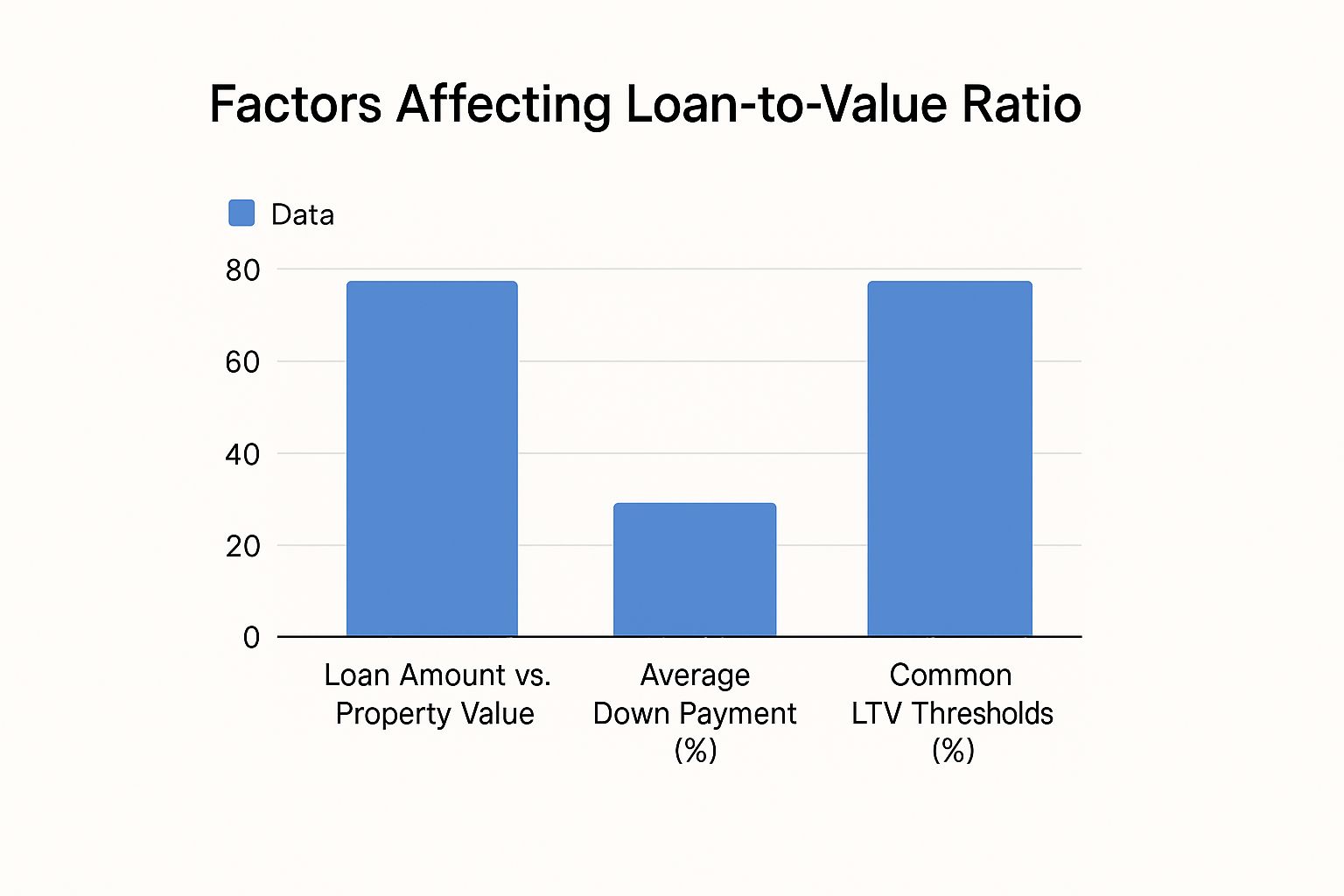
As you can see, it's all about the balance. The lower your loan amount is compared to the property's value, the better your LVR, and the stronger your position as a borrower.
LVR Scenarios and Their Financial Impact
Let's put some real numbers to this to see how it plays out. We'll use a hypothetical $600,000 property purchase right here in the Mandurah area. The table below shows just how different the journey can be depending on your deposit.
| Scenario | LVR | Deposit Amount | Lenders' Mortgage Insurance (LMI) | Loan Product Access |
|---|---|---|---|---|
| Gold Standard | 80% | $120,000 | $0 | Full access to the most competitive rates and products on the market. |
| Common Scenario | 90% | $60,000 | Approx. $12,000 – $15,000 | Fewer lender options; may face slightly higher interest rates. |
| High LVR | 95% | $30,000 | Could exceed $25,000 | Very limited choice of lenders; application scrutinised heavily. |
The difference is pretty stark, isn't it? Just by moving from a 10% deposit to a 20% deposit, you could save over ten thousand dollars instantly on LMI alone. That doesn’t even account for the long-term savings you’ll make by securing a better interest rate. This is exactly why putting in the hard yards to save for that 20% deposit is one of the smartest financial moves any home buyer can make.
Practical Strategies to Improve Your LVR
If your current Loan to Value Ratio (LVR) is higher than you’d like, don’t stress. There are several powerful and practical steps you can take to bring it down, which will strengthen your position as a borrower and save you a lot of money in the long run.
The most direct method is also the most obvious: saving a larger deposit. Every extra dollar you put down directly shrinks your loan amount, which in turn lowers your LVR. It definitely takes discipline, but hitting that magic 20% deposit (an 80% LVR) is the surest way to dodge Lenders' Mortgage Insurance (LMI) and get your hands on the best loan products available.
Leverage Support and Government Schemes
Another great strategy is to use a guarantor loan. This is where a close family member, usually a parent, uses the equity in their own home as extra security for your loan. From a lender’s perspective, this can slash your LVR and often helps you avoid LMI altogether, even if your cash deposit is on the smaller side.
Don't forget the Australian Government also has schemes specifically designed to help eligible buyers get into the market sooner.
- The First Home Guarantee: This lets eligible first-home buyers purchase a property with as little as a 5% deposit without having to pay for LMI.
- The Regional First Home Buyer Guarantee: It works just like the one above but is targeted at buyers in regional areas.
- The Family Home Guarantee: This one supports eligible single parents with at least one dependent child, allowing them to buy a home with a deposit as small as 2%.
These programs are fantastic for bridging the gap and helping buyers overcome the deposit hurdle that so often keeps homeownership just out of reach.
Remember, a lower LVR isn't just about getting your loan approved; it's a long-term financial strategy. It reduces your overall loan cost, improves your borrowing power, and gives you more control over your financial future.
Finally, never underestimate the power of property value growth. Over time, as your home’s value increases, your LVR will naturally fall, assuming your loan balance is also ticking down. This passive improvement can unlock some serious advantages later on, especially when you're ready to refinance for a better deal. Being prepared for this is key, which is why understanding the process for getting your home loan pre-approval is always a smart move.
Your Common LVR Questions Answered
Digging into the loan-to-value ratio often brings up a few curly questions, especially when you're trying to figure out how it all works in the real world of buying a home. Here are some straightforward answers to the queries we hear most often from Mandurah buyers.
Can I Get a Home Loan with an LVR Over 90 Percent?
Yes, it's definitely possible to get a home loan with an LVR up to 95% here in Australia, but it’s not a walk in the park. Lenders keep these loans for applicants with a rock-solid financial footing—think stable, high income and a squeaky-clean credit history.
You'll also almost certainly be up for a hefty Lenders' Mortgage Insurance (LMI) premium. That said, there are government schemes like the First Home Guarantee designed to help eligible buyers get into the market with a small deposit, without the LMI sting.
Does My LVR Affect My Ability to Refinance?
Absolutely. Your LVR is a make-or-break factor when you want to refinance your home loan down the track. To get your hands on the sharpest refinancing deals, most lenders will want to see an LVR of 80% or lower. This proves you have at least 20% equity built up in your property.
If your LVR is sitting higher than that, you might find it tough to get a lender on board. You could also be looking at higher interest rates or even having to pay for LMI all over again. Building that equity is your ticket to better refinancing options.
A lower LVR doesn’t just help you buy the property; it gives you serious financial firepower and flexibility to save a bundle years later through refinancing.
How Does a Bank Determine My Property's Value?
A lender won’t just take your word for it on the purchase price. They’ll bring in their own expert to conduct an independent property valuation. A professional valuer will look at everything—the home’s location, its condition, size, and what similar properties nearby have recently sold for—to land on its true current market value.
If this valuation comes in lower than what you’ve agreed to pay, it will push your LVR up. This can sometimes throw a spanner in the works for your loan approval or mean you have to scramble to find a bigger deposit to keep the lender happy.
Navigating the Mandurah property market takes local knowledge and a clear game plan. For a free, no-obligation appraisal of your property's value, get in touch with David Beshay Real Estate at https://realestate-david-beshay.com.au and make your next move a confident one.


Pingback: How to Get a Home Loan in WA: Your Practical Guide - David Beshay Real Estate - The Agency
Pingback: How to Calculate Borrowing Capacity in Australia - David Beshay Real Estate - The Agency
Pingback: House Deposit Calculator Australia | Plan Your Savings Today - David Beshay Real Estate - The Agency