


Securing a home loan in Western Australia can feel like a massive undertaking, but it’s really just a series of clear, logical steps. The secret is to get your own financial house in order first, before you even think about talking to lenders. Once that’s done, you can move methodically through comparing lenders, submitting your application, and finally, getting to settlement.
Your WA Home Loan Journey Mapped Out
Navigating the path to homeownership in WA is all about having a clear strategy. From that initial financial health check to finally getting the keys in your hand, each step builds on the last. When you understand the sequence, a lot of the stress just melts away, empowering you to make decisions with confidence. It’s less of a giant leap and more like a series of well-planned moves.
This first stage—checking your credit history, crunching the numbers on your budget, and getting your head around the different loan types—is the absolute foundation for your success.
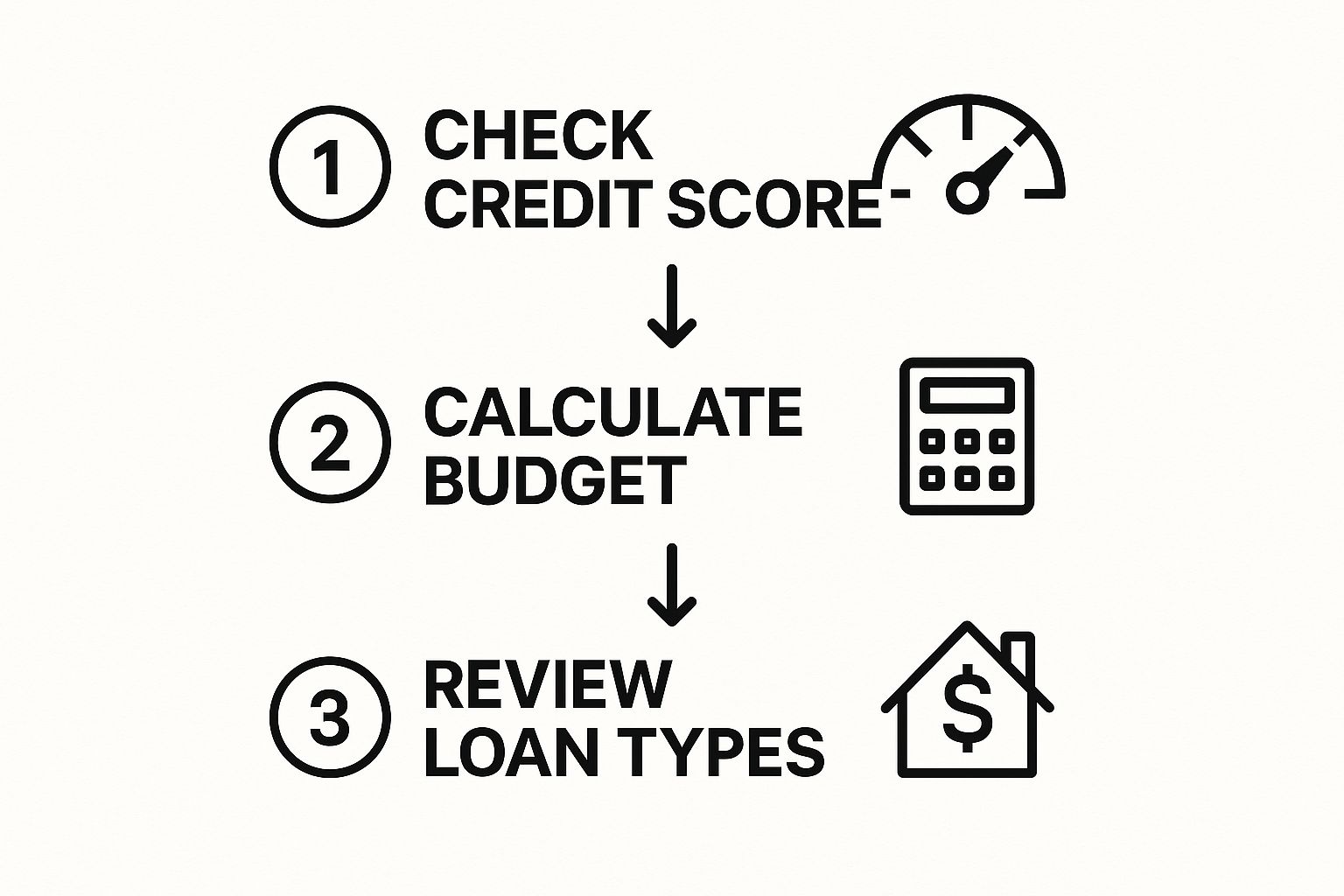
Getting these preliminary stages right puts you in a powerful position before you even begin talking to a bank or broker. You’ll be approaching the whole thing from a position of strength, not uncertainty.
Key Milestones on Your Path to a Home Loan
The actual process is pretty consistent across most lenders here in WA. It follows a logical flow from your own self-assessment right through to the official settlement day. Knowing what's coming next helps you get the right documents and the right mindset ready for each phase. This simple bit of prep work can help you sidestep the common delays and frustrations that catch so many first-time buyers off guard.
Think of it as your strategic checklist for success.
A well-prepared borrower is a lender's ideal client. By organising your finances and documents ahead of time, you signal responsibility and significantly speed up the approval process.
To give you a clear roadmap of what to expect, we've broken down the critical stages you'll encounter. Each milestone has its own goal and a typical timeframe, so there are no surprises along the way.
Home Loan Journey Milestones in WA
This table outlines the critical stages in the home loan application process, from your initial preparation all the way to settlement.
| Milestone | Key Objective | Typical Timeline |
|---|---|---|
| Financial Preparation | Assess savings, credit score, and borrowing power. | 1-3 months |
| Lender Comparison & Pre-Approval | Choose a lender and secure conditional approval. | 2-4 weeks |
| Property Search & Offer | Find a home and make a formal offer. | 1-6 months |
| Formal Application & Valuation | Submit final documents for unconditional approval. | 2-3 weeks |
| Loan Settlement | Finalise legal work and transfer of funds. | 4-6 weeks |
Understanding these key phases helps demystify the journey, turning a daunting process into a manageable and exciting project. With this timeline in mind, you can plan effectively and move forward with confidence.
Looking Good for the Lenders: Strengthening Your Financial Profile

Before you even think about comparing interest rates, the very first step is to take a good, hard look at your finances. Lenders in WA aren't just looking at your payslip; they want to see a clear, consistent picture of your money habits. They're digging into how you manage your money from one payday to the next.
This means building a solid financial profile is your first real hurdle. It’s about more than just having an income—it's about scrutinising your own bank statements, understanding your credit history, and proving you have the discipline to save a deposit.
It’s All About "Genuine Savings"
In lender-speak, genuine savings are funds you've personally saved and held onto for at least three months. This isn't a gift from a relative that landed in your account last week. It's concrete proof that you can consistently put money aside, which tells a lender you're a good bet for managing future mortgage repayments.
A lender will want to see regular deposits into a savings account that line up with your pay cycle. For example, a fortnightly transfer of $500 that matches your salary payment looks far more convincing than a random, large, unexplained deposit. They're looking for that pattern of financial discipline.
Think of your bank statements as your financial resume. Lenders will comb through the last three to six months to assess your spending habits, how you manage your debts, and your capacity to save. Red flags for them include frequent overdrafts, a bunch of buy-now-pay-later transactions, or any evidence of online gambling.
This is also where your deposit size really matters. The bigger your deposit, the lower your loan-to-value ratio (LVR). A lower LVR dramatically improves your chances of getting approved and can help you dodge the hefty cost of Lenders Mortgage Insurance (LMI). To get a better handle on this crucial number, check out our guide on what the loan-to-value ratio is and why it matters.
Your Credit Score Is Your Financial Reputation
Your credit score is basically a number that sums up how reliable you are as a borrower. Lenders use it as a quick way to gauge the risk of lending you hundreds of thousands of dollars. A higher score—typically 700 or above—signals you’re a responsible borrower and can open the door to better interest rates and more flexible loan terms.
You can grab a free copy of your credit report from agencies like Equifax, Experian, or illion. When you get it, check it for:
- Accuracy: Make sure all the debts and accounts listed actually belong to you.
- Payment History: Look for any late payments or defaults. These are the things that drag your score down.
- Credit Enquiries: Too many applications for credit (like credit cards or personal loans) in a short space of time can look desperate to a lender.
If your score is a bit lower than you'd like, don't panic. You can improve it by simply paying all your bills on time, every time, and chipping away at any existing credit card debt. A bit of financial housekeeping can make a massive difference in how lenders see you.
Create a Budget Lenders Will Love
A detailed household budget does more than just show you where your money goes; it gives you a realistic idea of your true borrowing power. Lenders will do their own assessment, of course, but coming to them with your own solid budget shows you’re prepared and you understand your own financial limits.
The recent explosion in property values and borrowing sizes makes careful planning more important than ever. In Western Australia, the average mortgage size shot up by a staggering $72,000 between mid-2024 and mid-2025 alone, reflecting just how hot the market has been. By taking the time to build a strong financial profile now, you're setting yourself up to manage your loan confidently, no matter what the market does next.
Putting Your Paperwork Together

Alright, with your finances looking tidy, it's time to gather your documents. A well-organised application does more than just tick boxes—it shows the lender you're a serious, prepared borrower. This part is all about backing up everything you've said about your financial health, from what you earn to what you owe.
Think of it as building a file that tells your complete financial story. Lenders in WA need this documentation to verify who you are, check your income stability, and get a clear picture of your assets and liabilities. The easier you make this for them, the quicker your application will move.
The Core Documents Everyone Needs
No matter if you're a PAYG employee or running your own show, every lender will ask for a standard set of documents to get the ball rolling. Having these ready to go will save you from those frustrating back-and-forth emails and phone calls that always seem to cause delays.
Get these items scanned and saved in a dedicated folder on your computer:
- 100 Points of Identification: This usually means a combination of your driver’s licence, passport, and Medicare card.
- Proof of Income: Your two most recent payslips plus your latest group certificate or tax assessment notice should do the trick.
- Bank Statements: You'll need at least three months of statements for all your transaction and savings accounts. These need to clearly show your income, regular expenses, and that all-important genuine savings history.
This initial batch of paperwork is the foundation of your entire home loan application.
Pro Tip: Don't just dump all your files into one email. Give them clear, sensible names—like "John_Smith_Payslip_June24.pdf" or "Jane_Doe_Bank_Statement_May24.pdf". This tiny bit of organisation makes a huge difference to the person assessing your file and reflects really well on you.
PAYG vs. Self-Employed: The Key Differences
How you earn your living will determine exactly what kind of income evidence you need to provide. Lenders are always looking for consistency and reliability, and the documents they ask for reflect that.
For PAYG (Pay As You Go) employees, the process is pretty straightforward. Your income is consistent and easy for them to verify.
If you're self-employed, however, lenders need a much more detailed picture of your business's financial health before they can feel confident about your earnings. This usually means digging up at least two years' worth of financial records.
| Applicant Type | Primary Income Documents Needed |
|---|---|
| PAYG Employee | Two most recent payslips, recent group certificate, and sometimes a letter from your employer. |
| Self-Employed | Two full years of personal and business tax returns, plus your ATO Notices of Assessment. |
Getting these documents sorted is a crucial hurdle. A complete and organised submission can seriously cut down your processing time, helping you lock in that pre-approval faster so you can start hitting the open homes with confidence.
Choosing the Right Lender in the WA Market
You’ve got your finances sorted and your paperwork ready to go. Now for the big decision: who are you going to get your home loan from? The Western Australian market is absolutely swimming with options, from the big four banks you see on every corner to smaller credit unions and a growing number of online-only lenders.
It’s so easy to get tunnel vision and just chase the lowest advertised interest rate. But trust me, the best deal is rarely the one with the biggest number on the billboard. The real value is buried in the details.
A good place to start is just getting your head around the different types of lenders. The major banks offer a massive range of products and the convenience of a physical branch. Credit unions, on the other hand, are member-owned and often hang their hat on top-notch customer service. Then you’ve got the non-bank lenders, who can sometimes be a lifeline with more flexible criteria if you don't neatly fit the traditional borrower box.
Looking Beyond the Headline Rate
If there’s one thing you need to understand, it’s the comparison rate. This isn't just jargon; it's a legally required figure that bundles the interest rate plus most of the upfront and ongoing fees into a single percentage.
Think of it as the "true cost" of the loan. It stops lenders from luring you in with a super-low headline rate while hiding a mountain of fees in the fine print.
For example, Loan A might have a flashy 5.80% interest rate but sting you with high application fees. Meanwhile, Loan B sits at 5.95% but has next to no fees. The comparison rate will often reveal that Loan B is actually the cheaper option over the life of the loan. Always, always compare loans using this number.
Fixed vs Variable Rates: What's Right for You?
The next big fork in the road is deciding whether to lock in a fixed interest rate or ride the waves with a variable rate. With over 400 home loan products floating around, getting this right is crucial.
Recently, the average variable home loan rate for owner-occupiers was hovering around 6.15% per annum, while 3-year fixed rates were closer to 5.42%.
A fixed rate gives you certainty. Your repayments won’t budge for a set period (usually 1-5 years), which makes budgeting a breeze. A variable rate, however, moves with the market. If rates drop, you save money. If they rise, so do your repayments. Can't decide? Many borrowers hedge their bets with a split loan, fixing one part of their mortgage and leaving the rest variable.
Your choice between a fixed and variable rate really boils down to your personal risk tolerance and what you’re trying to achieve. Are you after the stability of predictable repayments, or are you comfortable with a bit of market fluctuation for the chance to save?
Here's a quick breakdown to help you weigh up the pros and cons.
Comparing Fixed vs Variable Home Loan Features
| Feature | Fixed Rate Loan | Variable Rate Loan |
|---|---|---|
| Repayment Stability | Repayments are locked in and predictable for the fixed term. | Repayments can rise or fall with market interest rates. |
| Budgeting | Makes it very easy to budget for your mortgage payments. | Can be harder to budget for, as repayments can change. |
| Flexibility | Often has limits on extra repayments and may charge break costs. | Usually allows unlimited extra repayments without penalty. |
| Features | May have fewer features like offset accounts, or they may be limited. | Typically comes with more features, like offset accounts and redraw facilities. |
| Interest Rate Risk | Protected from rate rises, but you'll miss out if rates fall. | You benefit from rate cuts, but you're exposed to rate increases. |
Ultimately, there’s no single "best" option—it's about what provides the right balance of security and flexibility for your specific situation.
Uncovering Hidden Fees and Essential Features
Once you're looking past the rate, it’s time to get forensic with the loan features and any associated costs. Does the loan have an offset account? This is a fantastic feature that links your savings account to your mortgage, reducing the amount of interest you pay. Is there a redraw facility that lets you pull back any extra repayments you've made?
These features can save you a fortune in the long run, but they sometimes come with higher annual package fees.
On the flip side, keep an eye out for sneaky costs that can add up:
- Application or establishment fees: A one-off charge just to get the loan set up.
- Valuation fees: The cost for the lender to send someone out to value the property.
- Monthly or annual package fees: Ongoing fees for the privilege of having the loan and its features.
The choice between going directly to a bank or using a mortgage broker is another big one. Each has its own pros and cons, and knowing the difference is key. Our guide comparing a mortgage broker vs a bank is a great resource to help you figure out which path makes the most sense for you.
From Pre-Approval to Making a Confident Offer
Getting your home loan pre-approval is the moment your property search kicks into high gear. It’s a conditional green light from a lender that tells real estate agents and sellers in WA you’re a serious contender with the financial muscle to back up an offer. Think of it as your golden ticket to start house hunting with real confidence.
Now, this isn't a blank cheque. The lender will still need to dot the i's and cross the t's on your financial documents, but it gives you a solid borrowing limit. This is huge—it lets you focus your search on homes you can actually afford, saving you the heartache of falling for a property that's just out of reach. You can dive deeper into the nuts and bolts of the process in our detailed guide on home loan pre-approval.
Turning Pre-Approval into a Powerful Offer
With that pre-approval letter in your back pocket, you’re in a much stronger position when it comes time to negotiate. Once you find the one, you can make an offer that feels both confident and compelling. This is especially important in a competitive market where sellers are often looking for the path of least resistance.
A pre-approved buyer is seen as less of a risk. It can even make your offer more appealing than a slightly higher one from someone who hasn't got their finances sorted. This preparation is a massive advantage in a market that continues to show strength. In the second quarter of 2025 alone, new owner-occupier loan commitments surged, with first-home buyer loans jumping by 5.7% after a dip in the previous quarter. You can explore more of these market trends on Trading Economics. It just goes to show that being prepared puts you ahead of the game.
Having pre-approval doesn't just show sellers you're serious; it dramatically speeds up the final loan application process once your offer is accepted. You've already done most of the heavy lifting.
The All-Important 'Subject to Finance' Clause
When you write up your formal offer, one of the most critical conditions to include is the 'subject to finance' clause. This is your safety net. It gives you a specific timeframe, usually between 14 and 28 days, to get your pre-approval converted into a full, unconditional loan approval.
If for some reason your lender pulls back—maybe the property valuation comes in too low—this clause lets you legally walk away from the contract without losing your deposit. For any buyer, this is a non-negotiable layer of protection.
So what happens next?
- Submit the Contract of Sale: Once the seller accepts your offer, you’ll send the signed contract over to your lender.
- Property Valuation: Your lender will organise an independent valuation of the property to make sure it's worth what you're borrowing against it.
- Final Assessment: They’ll run one last check on your finances and the property details.
- Unconditional Approval: Once everything lines up, the lender issues formal, unconditional approval. You're now clear to move towards settlement
Navigating the Final Steps to Settlement Day

Getting that unconditional approval is a fantastic feeling, but don't pop the champagne just yet. The home stretch from formal approval to settlement day is a flurry of activity involving a few key players and some very important documents.
This is where your conveyancer or settlement agent really earns their keep, working behind the scenes to coordinate with your lender and the seller’s team for a smooth handover.
Your main task during this period is to carefully review and sign your loan contracts. These aren't just any documents; they are legally binding and lay out every single detail of your mortgage—the loan amount, interest rate, repayment schedule, and all the terms and conditions. Take your time, read them thoroughly, and never hesitate to ask your broker to clarify anything that seems unclear.
Final Checks and Essential Paperwork
With the loan documents in hand, there are a few final hurdles to clear. While your lender has already done a formal property valuation, you now need to sort out your building and contents insurance. This is non-negotiable.
Lenders won’t advance a single dollar until they have proof of insurance, which comes in the form of a Certificate of Currency.
Meanwhile, your conveyancer will be busy conducting final title searches and preparing all the transfer documents. They’ll also send you a settlement statement, which breaks down the final amount of money needed to complete the purchase, including any adjustments for council and water rates.
Take a moment to double-check every detail on your loan contract and settlement statement. A simple typo can cause significant delays. It's much easier to fix a small issue now than on settlement day itself.
What Happens on Settlement Day
Settlement day is the grand finale—the moment the financial and legal handover officially happens. The good news is you usually don’t need to be there in person; your conveyancer represents you.
Here’s a quick rundown of the day’s events:
- Fund Transfer: Your lender releases the loan funds to your conveyancer’s trust account.
- Payment to Seller: Your conveyancer uses these funds, plus your contribution, to pay the seller the outstanding purchase price.
- Title Transfer: The property's title is officially transferred into your name.
- Keys Released: Once the seller's agent confirms the funds have cleared, they get the green light to release the keys to you!
After the long journey of figuring out how to get a home loan, this is the moment it all becomes real. It’s a day of coordination and legal formalities that ends with the best part: picking up the keys to your new WA home.
Your Top Home Loan Questions Answered
Even with the best plan, you're bound to have a few lingering questions. It's completely normal. To help you feel more confident, I've put together answers to some of the most common queries I hear from WA buyers.
How Much Deposit Do I Really Need in WA?
Everyone talks about the magic 20% deposit, and for good reason—it helps you sidestep Lenders Mortgage Insurance (LMI). But let's be realistic, that's a huge hurdle for many.
The good news? It's not a dealbreaker. Plenty of lenders right here in WA are open to applications with deposits as low as 5%. Plus, if you're a first-home buyer, government schemes like the First Home Guarantee can be a massive leg-up, drastically cutting the deposit you need to save. Just don't forget to budget for the other upfront costs like stamp duty and legal fees; they're separate from your deposit.
What Is a Comparison Rate and Why Should I Care?
Ever seen a home loan advertised with a super-low interest rate, only to find the fees are sky-high? That's exactly what the comparison rate is designed to prevent.
It’s a single percentage that bundles the interest rate plus most of the loan's fees. Think of it as the true cost of the loan. It stops lenders from hiding hefty fees behind an attractive headline rate.
When you're weighing up different home loans, always look at the comparison rate. It's the only way to get a genuine, apples-with-apples view of what you'll actually be paying over the long haul.
Can I Get a Home Loan in WA If I'm Self-Employed?
Yes, absolutely. Being self-employed doesn't lock you out of the property market.
The main difference is the paperwork. Instead of just showing recent payslips, lenders will need to see proof of consistent income. Typically, this means providing two full years of your business and personal tax returns, along with your ATO Notices of Assessment. Some specialist lenders also offer 'low-doc' loans, which require less documentation but often come with higher interest rates. It's a trade-off worth considering.
What Does the 'Subject to Finance' Clause Actually Do?
This little clause is your most important safety net when making an offer.
The 'subject to finance' condition gives you a specific window of time—usually 14 to 28 days—to get unconditional approval for your home loan. If for some reason your lender doesn't give you the final green light within that period, this clause allows you to legally walk away from the offer without losing your deposit. It’s an essential protection for every single buyer. Don't sign anything without it.
Navigating the Mandurah property market requires local expertise and a steady hand. For a free, no-obligation property appraisal and a personalised strategy, contact David Beshay Real Estate. Let's start your journey today at https://realestate-david-beshay.com.au.

