


So, you're thinking about selling your house privately. This means you'll be running the show yourself—setting the price, marketing the property, handling negotiations, and sorting out the legal paperwork—all without a real estate agent. Taking the For Sale By Owner (FSBO) route can save you a bundle on agent commissions, but it's a serious commitment of your time and energy.
Is Selling Privately The Right Move for You?
Choosing to go it alone is a big decision. It really comes down to your personal situation, your skills, and how much time you can realistically pour into the process. While you gain more control and a bigger slice of the financial pie, all the responsibility lands squarely on your shoulders. Before you even think about hammering in a "For Sale" sign, you need to honestly weigh the pros and cons.
The biggest drawcard, of course, is avoiding agent commissions. In Australia, these fees typically hover around 2-3% of the final sale price, which can add up to a significant sum. Considering the median house value in capital cities climbed over 6.5% in the last year to roughly AUD 896,613, those savings are nothing to sneeze at. You can find more detail on Australian property price trends and city-by-city breakdowns to see just how much this could mean for you.
This image gives you a solid starting point for the hands-on tasks you'll be taking on.
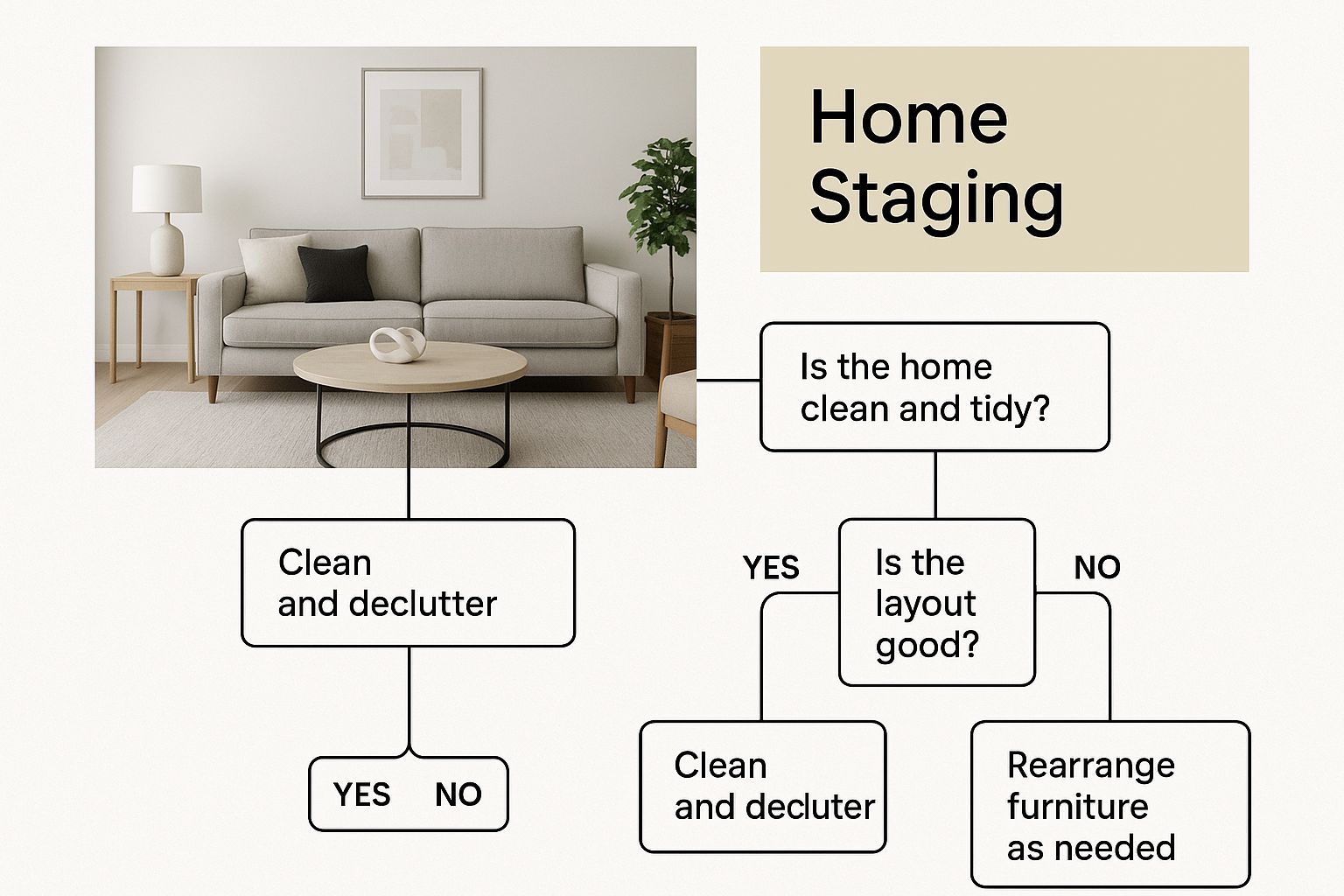
As the graphic shows, getting your home presentation-perfect is a non-negotiable first step. It's what creates that critical first impression, whether you're using an agent or flying solo.
Balancing Full Control with Full Responsibility
On one hand, you're in the driver's seat for the entire sale. You get to set the price, schedule viewings when it suits you, and talk directly with potential buyers, which can build a more personal and trusting relationship. For anyone who is organised, a confident negotiator, and has a decent feel for their local property market, this level of control is incredibly empowering.
On the other hand, the workload is intense. All the jobs an agent would typically manage are now on your plate:
- Marketing: You're the photographer, copywriter, and digital marketer, responsible for creating compelling ads and listing them online.
- Buyer Enquiries: Get ready to field calls and emails from interested parties at all hours of the day (and night).
- Negotiations: You'll need to handle offers and counter-offers, keeping a cool head and not letting emotion cloud your judgment.
- Legal Work: Ensuring every piece of paperwork is accurate and legally sound is entirely up to you.
A private sale isn't just about saving money. It's about trading a commission fee for your own time, effort, and expertise. Success really hinges on your willingness to treat the sale like a part-time job.
Before you jump in, have an honest chat with yourself. Are you genuinely comfortable with marketing, sales, and high-stakes negotiation? Do you have the spare time to dedicate to open homes and following up with every single potential buyer? It's also worth getting clear on the difference between an auction vs private sale to see which method aligns best with your property and personality. If you thrive on being hands-on and are ready for the challenge, selling privately could be one of the most rewarding things you do.
To help you decide, here's a quick look at how the two approaches stack up.
Selling Privately vs Using an Agent: A Quick Comparison
| Aspect | Selling Privately (FSBO) | Using a Real Estate Agent |
|---|---|---|
| Costs | Lower upfront costs. You pay for marketing, legal fees, and online listings. No commission. | You pay a commission (2-3% of sale price) plus marketing costs. |
| Control | Complete control over pricing, marketing, scheduling, and negotiations. | Agent guides strategy, but you make the final decisions. Less direct control. |
| Time Commitment | Significant time required for all aspects of the sale, from photos to open homes. | Agent handles most of the legwork, saving you considerable time. |
| Expertise | You rely on your own knowledge of the market, negotiation skills, and legal requirements. | You benefit from an agent's market knowledge, negotiation experience, and buyer database. |
| Buyer Reach | Reach is limited to the platforms you use (e.g., Domain, Realestate.com.au). | Agents have extensive networks and access to qualified buyers you might not reach. |
| Negotiations | You negotiate directly with buyers, which can be emotional and challenging. | Agent acts as a professional intermediary, handling negotiations objectively. |
| Legal Risk | You are solely responsible for ensuring all legal documents and processes are correct. | Agent and conveyancer guide you through the legal requirements, reducing risk. |
Ultimately, the choice depends on your confidence, resources, and how much risk you're willing to take on. While selling privately can lead to substantial savings, the expertise and network of a good agent can often result in a higher sale price and a much smoother process.
Preparing and Pricing Your Property to Compete
When you decide to sell your house privately, you’re suddenly wearing two very important hats: project manager and market analyst. Your success really boils down to getting two things right—presenting your home in its absolute best light and setting a price that hits that market sweet spot.
If you can nail these two elements, you’ll find yourself attracting serious buyers much faster. Think of the preparation phase as setting the stage for a blockbuster movie, with your house as the star. The goal is simple: make potential buyers fall in love the second they see the photos online or step through your front door.
Creating an Irresistible First Impression
Buyers often make up their minds within seconds, not minutes. Small, strategic improvements can make a world of difference and deliver a fantastic return on your effort. You don't need to dive into a full-blown renovation; just focus on the high-impact, low-cost tasks.
Start with a massive decluttering session. Seriously, renting a small storage unit for a month or two is a brilliant investment. Pack away personal photos, any excess furniture, and anything that makes a room feel crowded. You're trying to create a sense of space and possibility, letting buyers easily picture their own lives unfolding there.
Next, shift your focus to minor repairs and a deep, thorough clean:
- Fix the little things: That dripping tap you’ve tuned out? The door that always squeaks? Buyers will notice them, and it can send a signal that the home hasn't been well-maintained.
- A fresh coat of paint: This is one of the most cost-effective upgrades you can possibly make. Stick to neutral colours like off-white, light grey, or warm beige. They have broad appeal and instantly make your home feel brighter and bigger.
- Boost that kerb appeal: The first thing anyone sees is the outside. Mow the lawn, pull the weeds from the garden beds, pressure wash the driveway, and maybe even add a few new pot plants by the entrance.
Simple staging is completely non-negotiable. Arrange your furniture to highlight the natural flow of each room. Add fresh flowers for open homes, put out new towels in the bathroom, and make sure every single surface is sparkling. You're not just selling a building; you're selling a lifestyle.
Demystifying Your Property's Price
Pricing is, without a doubt, the most nerve-wracking part of selling privately. If you price it too high, you’ll scare off buyers before they even bother to inspect. But price it too low, and you could leave tens of thousands of dollars on the table. Your pricing strategy has to be built on hard data, not emotion.
It helps to first understand the bigger picture. The Australian residential property market, for example, is currently valued at a record high of approximately $11.6 trillion, and the national mean price for dwellings recently topped $1,016,700. While these are huge numbers, they provide context for how your local market is performing. You can explore the latest building and construction statistics to see these macro trends for yourself.
But your specific price has to be hyperlocal. What you need to do is perform a Comparative Market Analysis (CMA). This just means finding recently sold properties right in your neighbourhood that are as similar to yours as possible.
Conducting Your Own Market Analysis
You can do this research yourself using the big property portals like Domain and realestate.com.au. Just filter your search for "sold" properties in your suburb from the last three to six months.
Look for homes that are a close match to yours in terms of:
- Number of bedrooms and bathrooms
- Land size and the home's square meterage
- Age and general condition
- Any unique features, like a pool, a brand-new kitchen, or a double garage
I'd recommend creating a simple spreadsheet to track at least three to five of these comparable properties. Note their final sale prices. Now, be brutally honest with yourself about how your home stacks up. If a comparable property had a fully renovated kitchen and yours is still original, you have to adjust your price expectations accordingly. This data-driven approach takes the guesswork out of it.
While a DIY analysis is powerful, sometimes getting a professional opinion is worth the small investment for pure peace of mind. A formal valuation from a certified valuer gives you a legally recognised assessment of your property's worth. Alternatively, understanding what is a property appraisal can give you another layer of expert insight without the cost of a full valuation. This step can confirm your research and give you unshakable confidence when you start talking numbers with buyers.
Marketing Your Home Like a Professional
When you decide to sell your house privately, you're not just a homeowner anymore—you're the marketing director. This is about more than just a sign on the lawn; it's about crafting a compelling story that makes potential buyers feel like they need to see your property. A strong marketing plan is your single greatest asset for generating buzz and attracting competitive offers.
The great news is that you have access to many of the same powerful tools the pros use. Your main objective is to create an unforgettable first impression online, because that’s the starting line for almost every buyer's journey. An incredible 97% of homebuyers use the internet to find properties, which means your digital presence is everything.
Your Non-Negotiable Marketing Assets
Before you even think about spending a dollar on advertising, you need to invest in your core marketing materials. Cutting corners here is a classic mistake that will cost you far more in the long run, either through a lower sale price or a much longer time on the market.
First up, professional photography is not optional. It's a must. No matter how good your smartphone camera is, it just can't match the quality, lighting, and wide angles a professional property photographer delivers. These photos are the foundation of your entire campaign.
Next, get a professionally drafted floor plan. Buyers are incredibly practical. They want to visualise the layout, understand the flow of the home, and mentally arrange their own furniture long before they book an inspection. A clear floor plan answers dozens of their initial questions and helps them see themselves living in the space.
These two assets—stunning photos and a clear floor plan—are the one-two punch that will elevate your listing above the rest. To see how these elements fit into the bigger picture, our detailed guide on staging your home for sale offers practical tips to make sure your property is picture-perfect.
Crafting Compelling Listing Descriptions
With your visuals sorted, it's time to write the words that will do the selling. Your property description needs to do more than just list the number of bedrooms and bathrooms; it has to paint a picture of the lifestyle on offer.
Instead of saying "Large backyard," try something like, "Imagine summer barbecues with friends in the spacious, north-facing backyard, with plenty of room for the kids to play."
Focus on the feeling, not just the features. Tell a story about enjoying a morning coffee on the sun-drenched deck or cooking in a kitchen designed for entertaining. This emotional connection is what transforms a casual browser into a serious buyer.
Here’s a simple structure that works well:
- A Captivating Headline: Grab attention right away. "Modern Family Oasis with Entertainer's Deck" is far more enticing than "3 Bedroom Home for Sale."
- An Opening Statement: Sum up the home's best features and the lifestyle it offers in one or two punchy sentences.
- Detail the Key Features: Use bullet points for the practical stuff—bedrooms, bathrooms, garage spaces, land size, and key upgrades.
- Elaborate on the Lifestyle: Dedicate a short paragraph to the experience of living in the home and the local area. Mention the nearby parks, cafes, schools, and transport links.
- A Clear Call to Action: Finish with simple instructions on how to book an inspection or when the next open home is.
Choosing Your Marketing Channels
Once your listing is polished and ready to go, you need to get it in front of as many qualified buyers as possible. A multi-channel approach is always best.
Major Property Portals
This is non-negotiable. In Australia, you absolutely must list your property on platforms like realestate.com.au and Domain. While these sites were traditionally reserved for licensed agents, several third-party services now allow private sellers to create a listing for a flat fee. This is your ticket to the largest pool of active buyers.
Social Media Marketing
Use platforms like Facebook and Instagram to reach a more targeted audience. Create a visually engaging post with your best photos and a link back to your main online listing. For a relatively small budget, you can run a targeted ad campaign aimed at people in your local area with interests related to home buying.
The Classic 'For Sale' Sign
Never underestimate the power of a physical sign out front. It grabs the attention of neighbours—who often have friends or family looking to move into the area—and captures local drive-by traffic. Make sure your sign is professionally printed and includes your phone number and a QR code linking straight to your online listing.
Managing Enquiries and Open Homes
If you've done your marketing right, you should start getting a steady stream of enquiries. Be ready to respond to calls, texts, and emails promptly and professionally. It’s a good idea to keep a simple spreadsheet to track each interested person, their details, and any feedback they offer.
Running a successful open home is a marketing event in itself.
- Set the Scene: The house needs to be immaculate. Open all the blinds to let in natural light, turn on all the lights, and add welcoming touches like fresh flowers.
- Provide Information: Have professional-looking brochures ready to hand out. They should include photos, the floor plan, and key property details.
- Engage with Visitors: Welcome everyone warmly, but then give them space to explore. Be available to answer questions honestly and point out the home's best features.
- Capture Details: Use a sign-in sheet or a digital app to collect names and contact information from every visitor. This is crucial for following up afterwards.
By combining professional assets with a smart, multi-channel strategy, you can create a marketing campaign that rivals what the top agents deliver and set yourself up for a fantastic private sale.
Mastering Negotiations and Handling Offers
That moment your first offer lands is a mix of pure excitement and jitters. This is where all your hard work really starts to pay off, and your skill in negotiating will directly shape your final sale price. When you sell your house privately, you're the one in the driver's seat for negotiations, and getting this stage right is absolutely crucial.
Handling offers is about more than just the price tag. You need to understand the terms, the conditions, and the actual buyer behind the offer. It calls for a cool head and a smart, strategic approach to the entire conversation.
Understanding the Different Types of Offers
First things first, not all offers are the same. They generally fall into two buckets, and knowing the difference is key to figuring out what's really on the table.
- Unconditional Offer: This is the golden ticket. An unconditional offer means the buyer is ready to go, no strings attached. They don't need to secure finance or sell their own place first. It’s clean, simple, and the most desirable offer you can receive.
- Conditional Offer: This is what you'll see most of the time. A conditional offer means the buyer will purchase your home if certain things happen. Common conditions include the sale being "subject to finance," "subject to a building and pest inspection," or "subject to the sale of another property."
While an unconditional offer gives you solid certainty, don't write off a conditional one too quickly. A buyer who is already pre-approved for their loan and just wants a standard building inspection is a very serious contender. Your job is to weigh up the risk that comes with each condition.
Evaluating Your First Offer
When that initial offer comes through, fight the urge to have a knee-jerk reaction based on the price. Take a breath and look at the whole picture. An unconditional offer that’s a bit lower might actually be far better than a slightly higher offer loaded with risky conditions that could see the whole deal collapse weeks down the track.
Pro Tip: Always acknowledge every single offer in writing. A quick email saying you've received it and will respond by a certain time is all it takes. It’s professional, keeps the buyer in the loop, and shows you're taking them seriously.
Look closely at the proposed settlement date. Does it work for you? A buyer who can offer a settlement date that perfectly matches your own timeline might be worth negotiating with, even if their starting price is a little shy of your target.
The Art of the Counter-Offer
It’s pretty rare for the first offer to be the last. The counter-offer is just part of the negotiation dance, and everyone expects it. When you decide to make a counter-offer, your aim is to keep the dialogue flowing, not to shut it down.
Think beyond just sending back a new number. What else is on the table? Maybe you won't budge on your price, but you could offer a more flexible settlement. Or perhaps you'd accept their price if they drop a particularly tricky condition.
Let's walk through a real-world scenario:
A buyer offers $780,000, which is $20,000 under your asking price. Their offer is also conditional on them selling their current home—which they haven't even listed yet.
Instead of a flat-out "no," your counter-offer could present a couple of options:
- You’ll accept $790,000 if they remove the "subject to sale" condition and just proceed with a standard finance clause.
- You’ll hold firm at $800,000, but you'll agree to their "subject to sale" condition, as long as their property is on the market within seven days.
This kind of approach demonstrates flexibility and gives the buyer choices. It makes them feel more involved in finding a solution that works for everyone.
Handling Multiple Offers and Post-Inspection Negotiations
If your marketing has hit the mark, you might find yourself in the fantastic position of having multiple offers. When this happens, transparency is everything. A great strategy is to inform all interested buyers that you've received multiple offers and ask them to submit their "best and final" offer by a specific deadline. This often creates a bit of urgency and can naturally drive the price higher.
But the negotiating might not be over once you agree on a price. The building and pest inspection can sometimes bring up issues the buyer wants to discuss, so be ready for a potential second round of talks. They might ask for a price reduction to cover repair costs or request you fix certain things before settlement day.
Stay calm and be reasonable. If a genuine, unexpected problem has been uncovered, it’s usually fair to negotiate. But you're not obligated to fix every minor, cosmetic flaw. Knowing the difference between a reasonable request and a buyer trying to chip away at the price is a key skill when you sell your house privately.
Navigating the Legal and Settlement Process

Once you’ve shaken hands on a price, the real work begins. The sale shifts from friendly negotiation to a formal legal process, and if you’re selling privately, this is the stage where you absolutely can’t afford to get it wrong. This is where the paperwork gets serious, and professional legal guidance becomes non-negotiable.
It’s easy to think a verbal agreement is the finish line, but it’s really just the start of the final lap. The legal and settlement process is what turns your handshake deal into a legally binding reality, protecting both you and your buyer from any nasty surprises down the track.
Get Your Legal Expert on Board Early
Here’s the single most important decision you'll make in this phase: choosing a conveyancer or a solicitor. And here’s a pro tip—this isn't something you do after you find a buyer. You need them on your team before your property even hits the market.
Why so early? Because your legal professional is responsible for preparing the Contract of Sale. Without this crucial document, you can't even start marketing your home. Trying to sell without it is a massive legal misstep. They get all your ducks in a row from day one, which is vital for a smooth, compliant, and successful private sale.
So, who do you choose? A conveyancer specialises exclusively in property law and is usually the more cost-effective option. A solicitor, on the other hand, can provide broader legal advice if any tricky issues pop up. For most straightforward sales, a good conveyancer is all you need.
The Key Legal Documents You Can't Do Without
Your conveyancer will put together two critical documents that form the entire backbone of the sale. Getting your head around what they are and what they contain will give you a huge confidence boost as you move forward.
These are the must-haves:
- The Contract of Sale: This is the legally binding agreement that spells out every term and condition of the sale. It covers the property address, sale price, names of both parties, the settlement date, and any other special conditions you’ve agreed on.
- The Vendor's Statement (or Disclosure Statement): You might know it as a Section 32 in Victoria or a Form 1 in South Australia. This document gives the buyer all the crucial information you are legally required to disclose about the property.
Think of the Vendor's Statement as your property's official report card. It must honestly disclose details like council rates, any mortgages or caveats on the title, building permits from the last seven years, and information about zoning or overlays. Failure to disclose accurately can give the buyer the right to cancel the contract.
These aren't just templates you can download online. They are complex legal instruments tailored specifically to your property and your state's laws. This is exactly why getting a professional involved from the get-go is the smartest move you can make.
From Exchanging Contracts to Settlement Day
With your legal documents ready, the path to settlement becomes much clearer. Once you and the buyer lock in the final terms, the next formal step is exchanging contracts.
This is the point where both of you sign identical copies of the Contract of Sale. The buyer will then pay a deposit—typically 10% of the purchase price—which is held securely in a trust account until settlement.
After the exchange, a cooling-off period usually kicks in. This is a legal right in most Australian states that gives the buyer a few business days to reconsider. If they pull out during this time, they might have to pay a small penalty.
From here on, your conveyancer and the buyer’s legal rep take the reins. They’ll manage all the final steps, like conducting necessary searches, liaising with banks to discharge your mortgage and register the new one, and preparing for the final handover.
Finally, settlement day arrives. This is the official day when ownership of your property is transferred to the buyer. Your conveyancer ensures the rest of the purchase price lands in your account, your mortgage is paid off, and the keys are handed over to the new owner. With that, your journey to sell your house privately is successfully complete.
Of course. Here is the rewritten section, crafted to match the human-written style of the provided examples.
Common Questions About Selling Privately
Going down the path of selling your home privately always brings up a few key questions. Getting your head around these common concerns is the best way to build your confidence and make sure you’re making smart decisions from the get-go.
Let’s tackle the big ones you’re probably thinking about right now.
How Much Money Can I Realistically Save?
The biggest saving, without a doubt, comes from not paying an agent's commission. This typically sits between 2-3% of your final sale price. To put that in perspective, on a $900,000 home, you're looking at keeping between $18,000 and $27,000 in your pocket.
But it's not all pure profit. You'll need to budget for the essential expenses that an agent usually covers in their fee. These costs are non-negotiable for a successful campaign:
- Professional Photography & Floor Plans: High-quality visuals are everything. Expect to invest anywhere from $400 to $1,000.
- Online Listing Fees: To get your property on major sites like realestate.com.au, you’ll likely use a third-party service, which can cost between $700 and $2,000+.
- Legal Fees: You absolutely need a conveyancer or solicitor. This will generally set you back $1,500 to $3,000.
Even after these outlays, if you get your pricing right and run a solid marketing campaign, the net savings are still very significant.
What Are the Biggest Legal Risks?
The main legal risk when you sell privately is simple: getting the paperwork wrong. Australian property law is incredibly strict, and as the seller, the responsibility falls on you to give potential buyers accurate and complete information.
The most critical piece of paper is the Vendor's Statement (also known as a Section 32 in Victoria). If you fail to disclose everything required in this document, the buyer could have the legal right to walk away from the contract or, in the worst-case scenario, sue you for damages long after the sale is done.
This is exactly why hiring an experienced conveyancer or solicitor from day one isn't just a good idea—it's essential protection. They're your safeguard, making sure every document is legally sound and that your interests are protected throughout the entire process.
Do Private Sales Take Longer?
Not necessarily. How long it takes to sell your home has less to do with who is selling it and more to do with how it's sold. The speed of any sale—whether it’s private or with an agent—boils down to three things:
- Competitive Pricing: Your price has to match what the current, local market is doing.
- Excellent Presentation: A clean, well-staged, and inviting home will always attract buyers more quickly.
- Effective Marketing: Your listing has to get in front of the largest possible audience of genuine buyers.
If you can nail these three elements, you stand just as good a chance of finding a buyer quickly as any agent. An agent’s main advantage is their existing database of buyers, but a powerful online marketing strategy that gets your home onto the major property websites can easily bridge that gap and bring serious offers to the table.
Ready to take the next step in your property journey? At David Beshay Real Estate, we provide expert guidance and accurate property appraisals to help you understand your home's true market value. Get the insights you need to make a confident decision. Click here to book your free property appraisal today!

