


Jumping into the Mandurah commercial property market without a plan is like setting sail without a map. Before you even think about looking at listings, the most crucial work happens. Getting your strategy straight from the get-go is the difference between a savvy investment and a costly mistake.
This initial planning is your foundation. Without it, you can easily be swayed by a property that looks great on paper but doesn't actually fit your long-term goals.
Laying Your Investment Foundation
Think of it as building a house. You wouldn’t start pouring a slab without a detailed blueprint. Your investment strategy is that blueprint, making sure your purchase is built on solid ground.
Define Your Primary Investment Goal
First things first: what do you need this property to do for you? The answer will completely change the kind of property you should be looking for. Most commercial investors fall into one of three camps.
- Owner-Occupier: Are you buying a space for your own business to run from? If so, your priorities will be things like zoning, location, and a layout that suits your company's workflow. The investment return is secondary to the property’s practical function.
- Rental Income (Yield): Is the main game to generate steady, positive cash flow? Your focus will shift to properties with solid, long-term tenants, high rental demand, and leases that work in your favour.
- Capital Growth: Are you playing the long game? This is about buying an asset that you believe will be worth a lot more down the track. This approach often means sniffing out properties in up-and-coming areas, maybe something with development potential or a building that's ripe for a value-adding renovation.
Knowing which path you’re on is everything. An investor chasing yield might snap up a fully-leased retail shop on a busy Mandurah street. In contrast, someone focused on capital growth might see more potential in an old warehouse in an area earmarked for future infrastructure upgrades.
Understand the True Costs Involved
This is where so many new investors get tripped up. The purchase price is just the beginning. You need to budget for a whole range of other significant costs that can easily add 10% or more to your initial outlay.
Don’t forget to factor these into your numbers:
- Stamp Duty: A hefty government tax on the transaction.
- Legal and Conveyancing Fees: You’ll need a good solicitor to handle the contracts and settlement.
- Loan Establishment Fees: What your lender will charge to set up the commercial mortgage.
- Due Diligence Costs: Money for building inspections, pest reports, and sometimes even environmental checks.
- Initial Renovation or Fit-Out Funds: Cash set aside for any immediate work needed before you or a tenant can move in.
As a rule of thumb, I always tell clients to budget an extra 5-7% of the purchase price for transaction costs alone. On top of that, you need a separate contingency fund for any surprises. Getting this wrong can put your entire investment on shaky ground.
Mapping out these expenses properly means you have enough cash not just to buy the place, but to manage it well from day one. It's also worth noting that getting your head around the finances can uncover some real advantages. For instance, many investors are surprised by what they can claim at tax time. To get a better handle on this, you can learn more about the investment property tax benefits in our detailed guide.
Assemble Your Professional Team
Trying to buy a commercial property on your own is a classic rookie error. You need a team of specialists in your corner to help you avoid pitfalls and spot the real opportunities.
Your core team should include:
- A Commercial Real Estate Agent: Find an agent who lives and breathes the type of property you’re after in Mandurah. They’ll have local knowledge and access to deals that never even hit the open market.
- A Property Solicitor: You need a lawyer who specialises in commercial property law, not just standard residential conveyancing. The contracts are far more complex, and they’ll be the one to spot the risks.
- A Commercial Mortgage Broker: A good broker who gets the ins and outs of commercial lending is worth their weight in gold. The banks are much stricter with these loans, and a broker can connect you with the right lenders for your situation.
Finding Opportunities in a Competitive Market
The commercial property market, especially in a buzzing region like Mandurah, moves quickly. Let's be honest, it's a complex game. Success isn't just about having the cash ready to go; it's about knowing where to look and, more importantly, what you're looking for.
Getting your head around the different property types is your first real advantage. Industrial, office, and retail spaces all march to the beat of a different economic drum. An industrial warehouse near a logistics hub, for example, is all about e-commerce growth and efficient supply chains. A retail shop's value, on the other hand, is tied directly to foot traffic, local demographics, and how much people are spending. An office building? Its success depends on local business confidence and the ever-changing trends of remote and hybrid work.
Looking Beyond the Obvious Listings
Here’s a secret that experienced investors know well: the best deals are rarely found sitting on major real estate websites for weeks on end. If you want a genuine edge, you need to start thinking like an insider and exploring the avenues most buyers completely miss. This means going way beyond a simple web search.
A well-connected commercial agent is worth their weight in gold here. They often get the inside scoop on properties long before they hit the open market. When you build a solid relationship with a great agent, you'll be the first person they call when a promising opportunity that fits your brief lands on their desk.
This is where having a professional team really pays off, opening doors to deals you'd never see otherwise.
This infographic breaks down the essential people you need on your team to help you find these hidden opportunities.
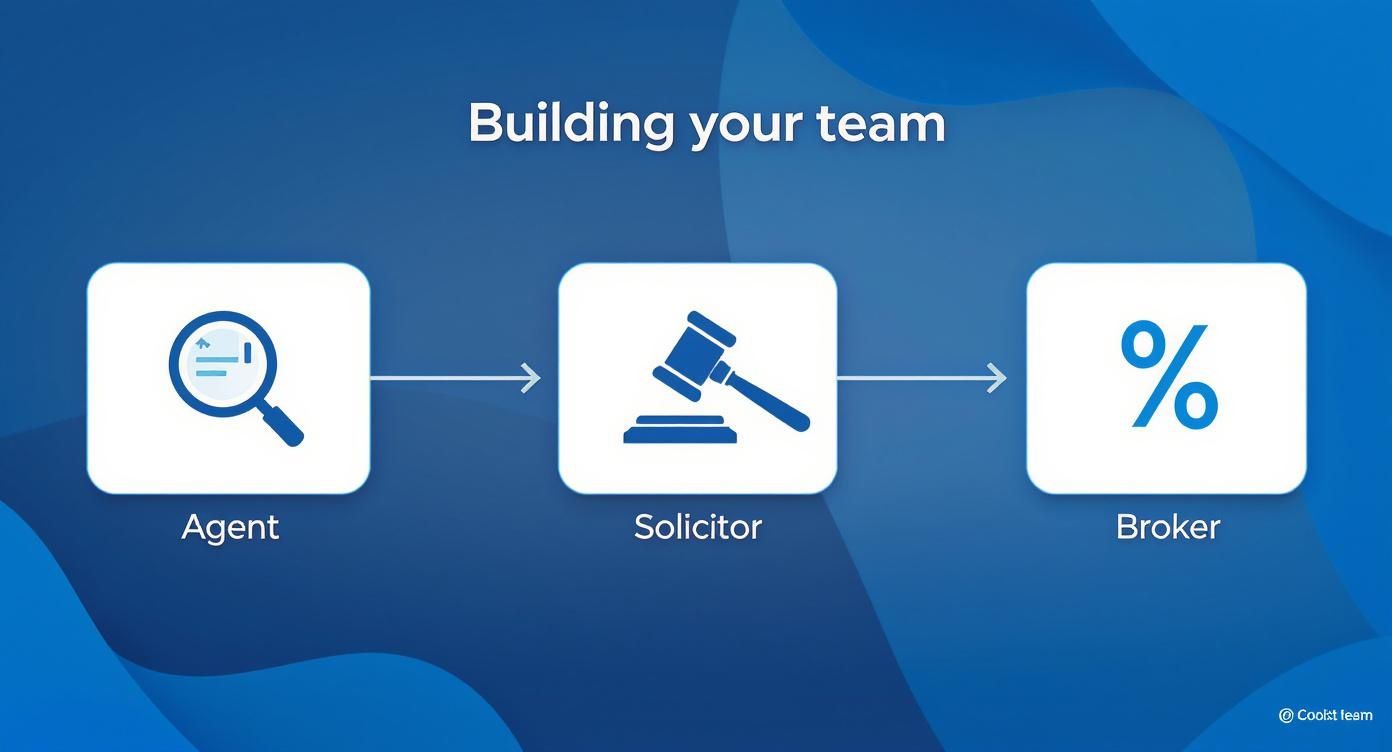
Putting together a team with a sharp agent, a detail-focused solicitor, and a savvy broker gives you a massive advantage in finding and closing high-value properties.
Many of these hidden gems are sold as off-market sales. These are properties sold privately without any public advertising. Sellers might go this route to quietly test the market or to avoid causing disruption for their existing tenants. If you're curious to learn more about this approach, have a look at our guide on the pros and cons of off-market sales.
Interpreting Market Signals
A truly strategic investor doesn't just see a building; they see its future. This skill comes from learning to read the signs—the subtle clues around a property that point to future growth or potential risks.
Start by digging into the local council's zoning regulations. A property zoned for "Mixed Use," for instance, could offer far more flexibility for future development or a wider variety of tenants than one with strict "Industrial" zoning. It's a small detail that can make a huge difference down the line.
Beyond zoning, keep a close eye on upcoming infrastructure projects. Is a new highway bypass being planned nearby? Is the local government pouring money into public transport upgrades? These kinds of developments can dramatically boost a property's accessibility and, in turn, its long-term value.
To get a snapshot of how different sectors perform, here's a look at the key metrics across major Australian markets.
Commercial Property Sector Snapshot
| Property Sector | Key Demand Drivers | Average Vacancy Rate | Typical Investment Profile |
|---|---|---|---|
| Industrial & Logistics | E-commerce growth, supply chain optimisation, manufacturing | ~1-3% (very low) | Institutional investors, private funds, high-net-worth individuals seeking stable, long-term returns. |
| Office (CBD & Fringe) | Business confidence, white-collar employment growth, flexible work trends | ~10-15% (variable) | REITs, institutional funds. Can offer higher yields but with more volatility tied to economic cycles. |
| Retail (Shopping Centres) | Consumer spending, population growth, tourism, experiential retail | ~5-8% | Varies widely from large funds (major centres) to private investors (strip shops). |
| Retail (Large Format) | Household goods spending, housing market activity | ~3-5% | Often tightly held by specialised funds and private syndicates. |
This table shows just how different the risk and reward profile can be for each sector. Understanding these nuances is crucial before you commit your capital.
Securing Your Commercial Property Loan

Let's get one thing straight: financing a commercial property is a completely different ball game to getting a standard home loan.
Lenders aren't just looking at your payslip. They're far more interested in the property's potential to make money and the strength of your business case. You need to stop thinking like a borrower and start thinking like a business partner pitching a solid investment to the bank.
Understanding the Lender's Perspective
When you buy a house, the bank’s main concern is whether your salary can cover the mortgage. Simple. But with commercial property, their focus gets much wider. They're not just betting on you anymore; they're betting on the property itself.
Expect them to poke and prod the deal from every angle. Does it have a solid leasing history? Are the current tenants financially sound? Does the projected income comfortably cover the loan repayments and all the other running costs? The risk assessment is intense because the numbers are bigger and the stakes are higher.
A lender's number one priority is minimising their risk. They need total confidence that the property is a sound, income-producing asset that can pay its own way, even if your personal situation changes. Your job is to build that confidence.
This means your application has to be more than a stack of financial papers. It needs to tell a compelling story.
Crafting a Compelling Loan Application
A well-put-together application is your best weapon. It should anticipate every question a lender might have and answer it with clear, hard evidence. A great credit score alone won't get you over the line here.
Your application package needs to be professional and thorough. At a minimum, you'll need:
- A Detailed Business Plan: If you plan to occupy the property yourself, this needs to detail your business's history, how it operates, and your strategy for growth. Crucially, it must show how owning the premises will make your business stronger.
- Realistic Cash Flow Projections: For investors, this means forecasting rental income, vacancy rates, and all operating expenses for the next 3-5 years. These can't be pie-in-the-sky numbers; they must be backed by real market data.
- Comprehensive Financial History: Pull together several years of personal and business tax returns, profit and loss statements, and balance sheets. Being organised and transparent is key.
Think of it as an investment prospectus. You're selling the bank on the future success of your purchase.
Key Metrics Lenders Use
Lenders use a few core financial ratios to quickly gauge the risk of any deal. Getting your head around these will help you see properties through a banker's eyes before you even think about applying.
The two big ones are:
- Loan-to-Value Ratio (LVR): This is the percentage of the property's value the bank will lend you. Forget the 80-90% LVRs you see in residential loans; commercial lending is far more conservative.
- Interest Coverage Ratio (ICR): This ratio compares the property’s net operating income to the proposed interest payments. Lenders want to see a healthy buffer, ensuring the income can cover the interest by 1.25 to 1.5 times or more.
The Australian financing market reflects this cautious approach. The average LVR for commercial property often sits around 65%, meaning you should plan for a deposit of at least 30-35%. Recent data also shows the average commercial mortgage rate at 5.2%, with settlement times stretching out to 10-12 weeks due to stricter regulatory checks. You can dig into more detailed Australian commercial property survey findings to get a feel for the current climate.
Exploring Commercial Loan Products
Not all commercial loans are the same. The best fit for you depends on your situation—whether you're an investor or buying for your own business.
- Full-Documentation (Full-Doc) Loans: The most common type. You'll need to provide comprehensive financial records, but you'll usually get the most competitive interest rates.
- Low-Documentation (Low-Doc) Loans: These are aimed at self-employed people or businesses whose income is harder to verify through traditional paperwork. Expect to pay a higher interest rate and be offered a lower LVR to compensate for the lender's increased risk.
- Specialised Asset Finance: This covers properties with unique uses, like service stations or childcare centres. For these, you’ll often need a lender who has specific expertise in that sector.
Walking into a meeting with a clear understanding of these numbers and a professionally prepared application puts you in a powerful position. It shows you've done your homework and are ready to negotiate the best possible terms for your Mandurah commercial property investment.
Your Essential Due Diligence Checklist

This is where the real work begins. Up until now, you've been dealing with strategy and getting your finances in order. Now it's time to put on your detective hat.
Due diligence is, without a doubt, the most critical phase for protecting your capital when buying a commercial property. It’s an intensive, deep-dive investigation into every single aspect of the asset, designed to uncover any hidden problems before you're locked into the purchase. Rushing this process or cutting corners is a surefire way to run into trouble later on.
A thorough check ensures the property you think you're buying is the one you actually get—with no expensive surprises waiting for you down the track.
For a more detailed look at the core principles, have a read of our guide on what due diligence in real estate truly involves.
The Physical Inspection Deep Dive
A quick walk-through just won’t cut it. You need to get qualified experts on-site to scrutinise the building’s physical condition from top to bottom. This goes way beyond looking for a few cosmetic scuffs; we're talking about the expensive, structural components that can make or break an investment.
Here are the key areas you'll need a professional to inspect:
- Structural Integrity: A building engineer needs to get in there and check for any issues with the foundation, load-bearing walls, and the overall structure.
- Roofing and Plumbing: A leaky roof or old, failing pipes can lead to catastrophic damage. You need an expert opinion on their current condition and how much life they have left.
- HVAC Systems: Commercial heating, ventilation, and air conditioning systems are incredibly expensive to replace. You need to know exactly how old they are and see the maintenance history.
- Building Code and Accessibility Compliance: Does the property meet all current Mandurah council regulations, including disabled access requirements? Falling short can lead to hefty fines and forced, costly upgrades.
Think of it this way: the money you spend on professional inspections isn't a cost—it's an investment. A few thousand dollars spent now could easily save you from a $100,000 repair bill a year after you've settled. It’s the best insurance policy you’ll ever buy.
To help you stay organised, I've put together a checklist of the absolute must-do's. This table breaks down what you need to look at and who you should be calling to get the job done right.
Essential Due Diligence Checklist
| Category | Key Checks to Perform | Professional to Consult |
|---|---|---|
| Physical Condition | Full structural assessment, roof condition, HVAC system age & function, plumbing & electrical systems review, accessibility compliance (e.g., AS 1428.1). | Building Engineer, Licensed Plumber & Electrician, Accessibility Consultant |
| Financial Health | Audit 3+ years of profit & loss statements, verify all tenant leases, scrutinise rent roll, cross-check claimed outgoings with actual bills. | Commercial Accountant, You/Your Agent |
| Legal & Title | Conduct a comprehensive title search for easements or caveats, confirm zoning with the City of Mandurah, review the property survey against title boundaries. | Conveyancer or Property Solicitor |
| Lease Agreements | Review every lease for expiry dates, rent review clauses (CPI, fixed, market), tenant responsibilities for outgoings, and any 'make good' clauses. | Property Solicitor, Commercial Property Manager |
This isn't an exhaustive list, but it covers the non-negotiables. Getting these fundamentals right protects you from the vast majority of potential pitfalls.
Scrutinising the Financials and Leases
A commercial property is only as strong as the income it produces. This is where you verify every single dollar of income and every expense the seller has claimed. You need to become an auditor and trust nothing until you've seen the paperwork that backs it up.
Start by getting your hands on all current lease agreements. These documents are the lifeblood of your investment, and you need to understand them inside and out.
Here's what to look for in those lease documents:
- Lease Terms and Expiry Dates: When does each lease end? A building with multiple leases all expiring around the same time is a major red flag.
- Rent Review Clauses: How and when does the rent go up? Is it linked to CPI, a fixed percentage, or a market review?
- Tenant Responsibilities: Who is on the hook for outgoings like council rates, insurance, and maintenance? This has a massive impact on your actual net income.
Beyond the leases, you must audit the property’s operating history. Insist on seeing at least three years of financial statements, profit and loss reports, and copies of all utility and maintenance bills. Compare these against what the seller has told you to make sure the numbers really do add up.
Legal and Title Verification
While you’re busy with the physical and financial side of things, your solicitor will be handling the crucial legal due diligence. This is a highly specialised area that ensures you receive a "clear title." In simple terms, this means the seller has the undisputed right to sell the property and that there are no hidden claims against it.
Your solicitor’s main tasks will include:
- Title Search: Confirming the legal owner and checking for any encumbrances, easements, or caveats that could limit how you can use the property.
- Zoning Verification: Officially confirming with the local Mandurah council that the property's current and intended use is permitted under local planning schemes.
- Survey and Boundary Check: Making sure the physical property boundaries on the ground match what’s on the legal title documents.
This legal deep dive is non-negotiable. An undiscovered easement could give a utility company the right to dig up your car park, or a zoning issue could stop your intended tenant from operating legally.
For certain property types, like offices, the process gets even more specific. Australia’s office real estate market is seeing a resurgence, with forecasted transaction volumes set to rise from A$9.8 billion to A$13.3 billion. For these assets, the typical 4-6 week due diligence period is heavily focused on the tenant mix, building certifications, and specific lease covenants. Investors chasing the common 6-8% annual returns in this sector have to be meticulous.
Negotiating and Closing the Deal
You’ve done the hard yards with your due diligence and now you have all the facts at your fingertips. This is where you switch gears from investigator to negotiator. The final stretch is all about securing the best possible terms and heading to settlement with confidence.
Remember, this isn't just about hammering down the price. A well-structured offer is your shield, protecting your interests, and can be just as crucial as a dollar-figure reduction. It’s time to use everything you've learned to your advantage and get this deal across the line.
Crafting a Compelling Offer
Your first offer really sets the stage for the rest of the negotiation. It has to come across as serious and well-researched, not just a lowball number you've pulled out of thin air. This is your chance to strategically use conditions—what we call 'subject to' clauses—to protect yourself.
These clauses essentially make the contract conditional on certain things happening. A 'subject to finance' clause, for example, is non-negotiable; it gives you an out if your lender has a last-minute change of heart. Another one I always recommend is a 'subject to satisfactory building and pest inspection' clause, even if you’ve already had a preliminary look.
A strong offer isn't always the highest one. I’ve seen sellers accept a slightly lower price because the offer had fewer conditions or a settlement date that suited them perfectly. Simplicity can be very appealing.
By putting some real thought into how you structure your offer, you’re showing the seller you’re a professional buyer who means business. That alone can make them much more open to negotiating on the terms that really matter to you.
Leveraging Your Due Diligence Findings
All those reports and inspections you paid for? This is where they start paying you back. The information you dug up during your due diligence is your biggest weapon in any negotiation, providing cold, hard evidence to back up your offer.
Did the building inspection reveal the commercial air conditioning unit is on its last legs and will cost $30,000 to replace? That’s a massive negotiating point. You can use this kind of information to:
- Go for a direct price reduction: Ask for the purchase price to be lowered to cover that future expense.
- Request the seller make repairs: Make it a condition of the sale that the seller fixes specific issues before settlement.
- Secure a special condition: Get the seller to agree in writing to contribute a certain amount towards the repair costs at settlement.
Even something smaller, like if your solicitor found a minor easement on the title that slightly restricts future development, can be used to argue the property's long-term value is affected. Using concrete facts like these turns the conversation from a matter of opinion into a business-like negotiation, which puts you in a much stronger position.
From Contract to Keys
Once your offer is accepted, you’re on the home stretch. The time between signing the contract and the official handover is called the settlement period. For commercial properties here in Australia, you’re typically looking at 60 to 90 days.
Your solicitor or conveyancer really takes the reins here. They’ll be coordinating with your bank and the seller’s legal team to make sure every box is ticked.
Here’s what typically happens during this time:
- Finalising Your Finance: Your lender will get their own valuation done on the property before giving you the final, unconditional loan approval.
- Conducting the Final Inspection: Right before settlement day, you’ll do one last walk-through to make sure the property is in the exact same condition as when you agreed to buy it.
- Settlement Day: This is the big day when legal ownership officially changes hands. Your legal team and lender handle the exchange of all the funds and documents.
Once settlement is complete, the property is all yours. The final step is also the most satisfying: collecting the keys. That moment signals the successful end of your journey, turning all that strategic planning and hard work into a real, tangible asset for your future.
Dipping your toes into the commercial property market for the first time always throws up a bunch of questions. It's totally normal. Getting straight answers is the best way to move forward and feel confident about your decisions. Here are some of the most common queries I hear from people just starting to figure out how to purchase commercial property.
How Much Deposit Do I Need for a Commercial Property?
This is usually the first question on everyone's mind, and for good reason—it's often the biggest hurdle. When it comes to commercial property, you can forget the 5% or 10% deposits you see in the residential market. The banks are a lot more cautious here.
In Australia, you really need to be prepared for a substantial deposit. As a general rule, lenders will want to see at least 30-35% of the purchase price. This higher entry barrier exists because commercial properties are considered a bigger risk. The exact amount can vary depending on the type of property, its location in Mandurah, the strength of your own finances, and which lender you're dealing with.
What Are the Main Differences Between Commercial and Residential Investment?
While both are 'property', they're completely different beasts as investments. The biggest distinctions come down to how the leases are structured, who pays for what, and how they perform when the economy changes.
- Lease Terms: Commercial leases are built for the long haul. We're talking 3, 5, or even 10-year terms. This offers a much more predictable and stable income stream compared to a standard 12-month residential lease.
- Tenant Responsibilities: This is a massive plus for commercial owners. Most tenants sign what's called a 'net lease', which means they're on the hook for outgoings like council rates, insurance, and day-to-day maintenance. That's less money coming out of your pocket.
- Market Sensitivity: The commercial world is closely tied to the economy's health. If businesses are struggling, it can be harder to find tenants. It can also take longer to fill a vacant commercial space than a residential one, so you need to be prepared for potentially longer periods without rent coming in.
Can I Use My Superannuation to Buy a Commercial Property?
Yes, you can, and it's a very popular strategy. It’s particularly powerful for business owners who want to buy the building their company operates from. The way to do this is through a Self-Managed Super Fund (SMSF).
But a word of warning: the Australian Taxation Office (ATO) has incredibly strict rules around this. Everything must pass the 'sole purpose test', meaning the property has to be managed purely to provide retirement benefits for the fund's members. If you get it wrong, the penalties are severe.
Using your SMSF is not a DIY job. You absolutely must get specialised financial and legal advice from professionals who live and breathe SMSF property investment before you even think about heading down this path.
What Does Yield Mean in Commercial Real Estate?
Think of yield as the report card for your investment property. It tells you exactly how hard your asset is working to generate income. The figure you really want to focus on is the net yield.
You calculate it by taking your total annual rent, subtracting all the property's running costs (management fees, insurance, rates, etc.), and then dividing that number by the total price you paid for the property. This gives you a percentage that shows the property's true performance and makes it easy to compare different investment opportunities on an apples-to-apples basis.
Navigating the Mandurah property market takes local knowledge and a partner you can trust. At David Beshay Real Estate, we offer the insights and strategic advice you need to make your next purchase a success. Whether you're buying, selling, or just weighing up your options, we're here to help you hit your property goals. Find out more about our services and how we can assist you.

