


Think of a reserve price auction as a property sale with a built-in safety net. It’s a way of setting a confidential, rock-bottom price you’re willing to accept, making sure your property doesn’t sell for a cent less than you’re comfortable with. This approach gives you the best of both worlds: the thrilling, competitive buzz of an auction, plus that all-important financial protection.
So, How Does a Reserve Price Auction Actually Work?
Let's say you're selling your stunning canal-front home in Mandurah. You know its worth, you've got a figure in mind you need to achieve, but you also love the idea of an auction driving the price sky-high. This is precisely where a reserve price auction shines. It establishes a "floor price," and the property simply cannot be sold below it. This puts you, the seller, firmly in control.
The reserve price itself is kept under wraps—it's a confidential figure known only by you, your agent, and the auctioneer. It’s your ace in the hole. Because potential buyers don't know the exact number, they're encouraged to bid based on what they think the home is worth, not just aiming for a visible target.
What Happens on Auction Day?
Picture this: it's auction day for your Mandurah property. The auctioneer kicks things off, maybe with a vendor bid just to get the ball rolling. As the bids start coming in, you can feel the energy in the air build. Then comes the critical moment—the bidding finally surpasses your secret reserve price.
This is when the auctioneer will declare the property is "on the market." For buyers, this is a massive psychological trigger. It’s a clear signal that the home will be sold to whoever places the highest bid from this point on. You'll often see the competition really heat up here, as anyone who was holding back suddenly realises it's now or never.
A great auction really comes down to three things: a quality property, a realistic reserve, and a room full of motivated buyers. That reserve price is your number one tool for making sure the outcome meets your financial goals.
The Real Magic of This Method
The genius of the reserve price auction is how it perfectly balances security with opportunity. It shields your asset from being undersold but also creates the ideal environment for buyer competition to really take off. The whole thing unfolds in a few distinct stages:
- Setting the Scene: Well before the auction, you and your agent will sit down and agree on a strategic, confidential reserve. This isn't a guess; it's based on solid market analysis and the feedback you've received from potential buyers.
- Building the Buzz: The bidding kicks off below the reserve. This encourages more people to get involved, creating momentum and building a competitive atmosphere right from the start.
- Hitting the Mark: As soon as the bidding hits or goes past your reserve, the property is officially declared "on the market."
- The Final Sprint: With the safety net now cleared, bidders compete freely and openly. This is where the magic really happens, often pushing the final sale price far beyond what you initially set as your reserve.
This structured process takes a huge amount of risk off your shoulders as a seller. Unlike an absolute auction where the property sells no matter how low the final bid is, a reserve price auction guarantees your bottom line is always protected. It's no wonder it's such a popular and effective strategy for sellers right across the vibrant Mandurah property market.
How to Strategically Set Your Reserve Price
Setting your reserve price is more of an art than a science. It's a delicate balancing act that can make or break your auction day, and it's a strategic decision you'll make in close collaboration with your agent. Think of it as turning a standard property appraisal into a powerful tool for your sales campaign.
This figure is your financial safety net. But if you set it too high, you risk scaring off bidders before the action even gets going.
The process doesn't start with a wild guess; it starts with hard data. A solid analysis of the Mandurah market is the cornerstone of a smart reserve price. This means looking beyond your own street to understand the bigger picture—the trends influencing buyer confidence across the entire Peel region.
Analyse the Local Market Landscape
First things first: you need to ground your expectations in reality. A good agent will provide a comparative market analysis (CMA), which is much more than just a list of recent sales. It’s a deep dive into what has recently sold, what’s currently for sale, and what failed to sell in surrounding suburbs like Lakelands, Halls Head, and Falcon.
This analysis is crucial for understanding what buyers are willing to pay right now for homes like yours. We'll look at a few key factors:
- Recent Comparable Sales: We focus on homes with similar features—bedrooms, bathrooms, land size, and condition—that have sold in the last 90 days.
- Current Competition: How many other similar properties are on the market? A high supply might mean your reserve needs to be a bit more competitive to stand out.
- Days on Market: How long are properties like yours sitting on the market? A fast-moving market can often support a firmer reserve.
This data-driven approach helps take the emotion out of the decision, letting you see your home through the eyes of a potential buyer. To get a better feel for this initial stage, you might want to check out our guide on how to get your house valued accurately.
Gauge Buyer Interest and Feedback
Your marketing campaign isn't just for advertising; it's a goldmine of real-time market intelligence. The feedback from open homes and private inspections gives you invaluable insight into how buyers are perceiving your property's value. You need to pay close attention to the level of interest and the quality of enquiries.
A successful auction boils down to three things: a quality property, a motivated group of bidders, and a realistic reserve. An unreasonably high reserve can put off genuine buyers and lead to a flat, disappointing auction day.
If you have dozens of groups coming through inspections and several people have requested the contract of sale, that’s a fantastic sign of healthy demand. On the flip side, if interest is lukewarm, it might be a hint that your initial price expectations need a slight adjustment. Your agent will pull all this feedback together to help you make a final, informed decision on the reserve just before the auction kicks off.
This flowchart shows that critical moment on auction day when the reserve price decides the outcome.
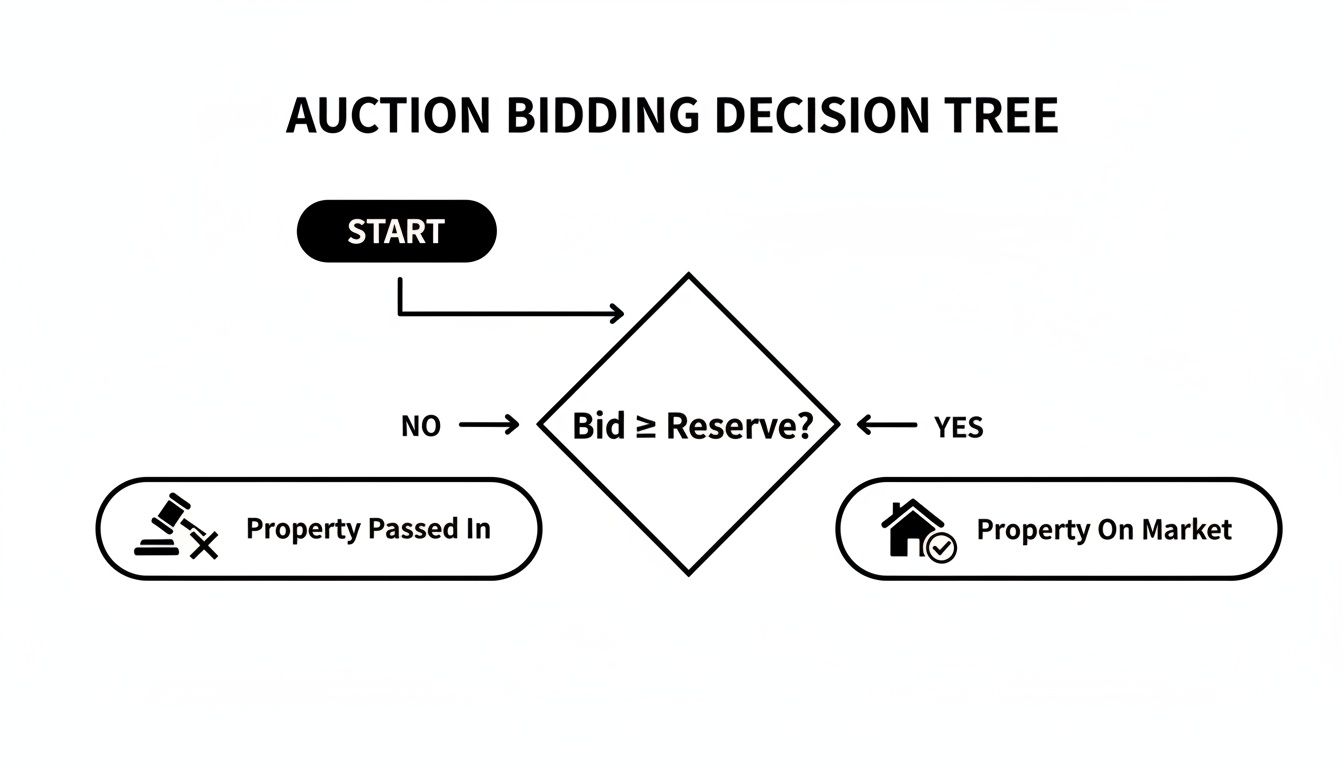
As you can see, until the bidding hits or surpasses the reserve, the property isn't sold. The second it does, the property is officially on the market and will be sold to the highest bidder.
Strike the Perfect Balance
Ultimately, the goal is to set a reserve that's both achievable and a little bit aspirational. It has to be a number you are genuinely happy to accept, one that meets your financial goals. But it also needs to be realistic enough to get the bidding started and create that competitive buzz where auction magic truly happens.
In the Australian property market, we know this strategy works. Recent data from Perth metro auctions shows that properties with strategically set reserves had a clearance rate of 72%.
This powerful statistic shows how a well-thought-out reserve price auction doesn't just protect your bottom line—it actively fuels the competitive bidding you need to smash your expectations.
Comparing Different Property Sale Methods
Choosing how to sell your Mandurah property is a huge decision. The path you take will directly impact how quickly you sell, how much control you have, and of course, the final number on the contract. A reserve price auction offers a fantastic mix of security and competitive fire, but it's vital to see how it stacks up against the other ways of selling.
To help you make the right call, let's put it head-to-head with two other common methods: the absolute (or no-reserve) auction and a traditional private sale. Each has its own personality, its own risks, and its own potential rewards.

Reserve Price Auction vs Absolute Auction
The biggest difference here is simple: a safety net. An absolute auction is exactly what it sounds like—there’s no reserve price. The property sells to the highest bidder on the day, no matter how low that final bid might be.
- Seller Control: With a reserve price, you’re in the driver's seat. You set the absolute minimum you’ll accept, protecting your bottom line. In an absolute auction, you hand over that control the moment the bidding starts.
- Risk Level: The risk for sellers is sky-high in an absolute auction. Sure, it guarantees a sale, but it offers zero protection against a low price. In a quiet market, that could be a disaster. A reserve price auction all but eliminates this financial risk.
- Buyer Urgency: Both create a sense of urgency, no doubt. But an absolute auction can sometimes attract more bargain hunters looking for a steal. A reserve price auction, on the other hand, tends to pull in serious, qualified buyers ready to compete at true market value.
An absolute auction guarantees a sale will happen, but a reserve price auction guarantees a sale will only happen at a price you are happy with. For most Mandurah homeowners, that protection is non-negotiable.
Reserve Price Auction vs Private Sale
A private sale, or private treaty as it's often called, is the most familiar way to sell a home in Western Australia. You list your home for a price or price range and then negotiate with buyers one-on-one. It’s a completely different beast compared to the open, time-driven environment of an auction.
The timeline is a major point of contrast. An auction campaign runs on a fixed schedule with a clear end date, which pushes buyers to act. A private sale is open-ended and can drag on for months if the initial asking price isn't spot-on with the market.
Then there are the conditions of sale. An auction sale is unconditional the moment the hammer falls—the winner is legally locked in with no ‘cooling-off’ period here in WA. Private sale offers, however, are often loaded with conditions like 'subject to finance' or building inspections, which can cause the whole deal to collapse weeks later. We dive deeper into this in our full guide to the auction vs private sale debate.
Comparing Sale Methods for Your Mandurah Property
To lay it all out plainly, here’s a simple table breaking down the three methods across the factors that matter most to you as a seller.
| Feature | Reserve Price Auction | Absolute Auction | Private Sale |
|---|---|---|---|
| Price Protection | Excellent (Seller sets a minimum price) | None (Sells to the highest bidder, no matter what) | Good (Seller sets an asking price, but may need to negotiate down) |
| Competition | High (Public bidding creates competitive tension) | Very High (Can attract bargain hunters and serious buyers) | Low to Medium (Negotiations are one-on-one) |
| Speed of Sale | Fast (Fixed auction date and campaign timeline) | Fastest (Guaranteed sale on the day) | Variable (Can take weeks or months) |
| Transparency | High (Bidding is open and public) | Highest (All bids are public and transparent) | Low (Offers are confidential between parties) |
| Certainty of Sale | High (Unconditional sale once reserve is met) | Guaranteed (Property will sell on the day) | Moderate (Subject to conditions and buyer withdrawals) |
For many Mandurah sellers, the reserve price auction really is the best of both worlds. It creates the transparent, competitive atmosphere you need to push for a premium price, but with the crucial safety net that both a private sale's lengthy negotiations and an absolute auction's high-stakes gamble simply can't offer.
Advantages and Disadvantages for Buyers and Sellers
A great auction is one where both the seller and the final buyer walk away feeling like they got a fair deal. To make that happen, you really need to understand how the process feels from both sides of the fence.
Seeing it this way shows why it’s such a popular method in the Mandurah property market, but it also shines a light on the different things each party needs to consider. At the heart of it all is the reserve price, which creates a unique set of pros and cons for everyone in the room.
The Seller's Perspective
For anyone selling their home in Mandurah, the biggest perks of a reserve price auction boil down to control and security. It offers a clear, structured way to chase a top-dollar sale without the terrifying gamble of a no-reserve auction.
Key Advantages for Sellers:
- Absolute Price Protection: This is the number one reason sellers choose this method. Your confidential reserve price is your financial safety net. It guarantees your property won’t sell for a single cent less than your absolute minimum, taking the risk of a bad auction day completely off the table.
- Creates a Competitive Floor: By starting the bidding well below the reserve, you draw more people into the action. This builds momentum and a fantastic competitive energy, which is exactly what you need to drive the price up once the auctioneer declares the property is 'on the market'.
- Certainty and a Fixed Timeline: An auction campaign has a firm end date. This deadline creates a sense of urgency for buyers and gets rid of the long, drawn-out negotiations and conditional offers that can bog down private treaty sales. It gives you a clear path forward.
A well-set reserve price doesn't just protect your bottom line; it fuels the entire auction. It gives bidders a launchpad and creates the perfect conditions for competition to thrive once that baseline is met.
Of course, no method is perfect. The main risk for a seller is that the bidding simply doesn't reach the reserve. If the property is ‘passed in’, it’s not a failure, but it does mean you're moving into post-auction negotiations, which can stretch out the timeline.
The Buyer's Perspective
For buyers, a reserve price auction is a refreshingly transparent and decisive way to buy a home. It can definitely be an emotional rollercoaster, but the rules of engagement are crystal clear and the whole process happens out in the open for everyone to see.
Key Advantages for Buyers:
- Complete Transparency: From the first bid, every offer is public knowledge. You know exactly what your competition is putting on the table, which gets rid of the frustrating guesswork and 'blind bidding' you often find in private sales.
- Confidence When 'On the Market': The second the auctioneer announces the property is 'on the market', you know it's definitely selling. That clarity lets you bid with confidence, knowing the highest bid from that point on will win the keys.
- A Level Playing Field: The auction process is fundamentally fair. Every registered bidder gets the same chance to buy the property under the exact same conditions. The winner is decided by one thing only: the highest offer.
However, buyers need to go in with their eyes open. The fast-paced, high-energy atmosphere can spark emotional bidding, and it's easy to get caught up and bid beyond your budget in the heat of the moment.
It’s also absolutely critical to remember that in Western Australia, an auction sale is final and unconditional. There is no 'cooling-off' period. This means all your homework—from getting your finance formally approved to doing your building and pest inspections—must be done before you even think about raising your hand.
Looking at recent auction data in Western Australia, it’s clear how reserve prices have been working in favour of sellers, especially in Mandurah's hot market. Data from REIWA shows WA auction volumes jumped by 45% in recent years, with clearance rates soaring from 55% to over 71%. In Mandurah, this has led to some amazing results where smartly set reserves not only boosted clearance rates but also saw final sale prices land an average of 14.2% above the reserve. It’s a powerful demonstration of strategic pricing in action. You can find out more about how strategic reserves are impacting Mandurah auction outcomes.
What Happens When the Reserve Price Is Not Met

It’s the question every seller has in the back of their mind: what if the bidding at my reserve price auction stalls and never hits that magic number? It’s a completely valid concern, but it’s important to see this scenario for what it really is.
When a property is ‘passed in’—meaning the highest bid falls short of the reserve—it’s not a failure. Not at all.
Think of it as the auction simply moving into its next, more focused phase: direct negotiation. This is where a skilled agent truly shows their value, turning a moment of potential disappointment into a successful sale. The auction has done its job perfectly by identifying the most motivated buyer in the market, giving you a crystal-clear starting point for a one-on-one conversation.
The Highest Bidder Gets Exclusive Rights
Under Western Australian auction law, the second the hammer falls on a passed-in property, the highest bidder earns the exclusive first right to negotiate with you. This is a powerful position to be in. The buyer has laid their cards on the table, proving they are the most serious person in the room.
Your agent immediately steps in to mediate, working to bridge the gap between their last bid and your reserve price. This all happens right there on the spot, away from the auction floor, creating a focused, private environment to hammer out a deal. More often than not, a final price is agreed upon within minutes of the auction ending.
A property being ‘passed in’ isn't the end of the story; it's the beginning of a direct, one-on-one negotiation with the most committed buyer. Your agent's negotiation skill is the key to turning that final bid into a signed contract.
This exclusive negotiation window is your best shot at securing a sale on the day under auction conditions, meaning the offer will be unconditional.
Navigating Post-Auction Negotiations
If you and the highest bidder strike a deal, the process is seamless. The contract gets signed, the deposit is paid, and the sale becomes legally binding—exactly as if the reserve had been met during the live bidding.
But what if you can’t quite agree on a price in that first negotiation? The property doesn't just hang in limbo. Your agent will have a clear, pre-planned strategy for this exact situation.
The next steps usually look like this:
- Opening Up Negotiations: If a price can't be agreed upon with the top bidder, your agent will then approach the underbidders—the people who came in second and third—to see if a deal is possible.
- Contacting Other Interested Parties: They will also get on the phone with everyone who showed genuine interest during the campaign but didn't put their hand up, perhaps because they were waiting to see what would happen.
- Transitioning to a Private Sale: If an immediate post-auction deal isn’t on the cards, the property smoothly transitions to a private sale listing.
This final step is an extremely common and effective strategy. The property is listed with a fixed price, often set at or just above your reserve, to capture any remaining buyer interest. You can get a better handle on this process by reading our guide on selling your property privately in WA.
Ultimately, a passed-in auction gives you incredibly valuable market feedback. It tells you exactly what the top-end buyers are willing to pay right now, arming you with the knowledge to either negotiate effectively or re-list your home at a price point proven to attract serious offers.
Common Questions About Reserve Price Auctions
Even after getting your head around the auction process, there are always a few specific questions that pop up for Mandurah sellers and buyers. This section is your quick-reference guide for clear, straightforward answers to the most common queries, so you can walk into auction day feeling confident and prepared.
Is the Reserve Price Disclosed to Bidders Before the Auction?
No, the reserve price is kept strictly confidential. The only people who know the number are you (the seller), your agent, and the auctioneer. This confidentiality is a cornerstone of a successful auction strategy.
Think of it this way: the whole point is to encourage bidders to compete based on what they think your property is worth, not just aim for a target number. If everyone knew the reserve, it would basically become a fixed-price sale, killing the competitive spirit that drives those incredible auction results.
The only clue anyone gets is that pivotal moment when the auctioneer declares the property is officially ‘on the market’. That’s the signal that your reserve has been met or passed.
The confidentiality of the reserve price is what keeps the bidding honest and competitive. Buyers bid what they believe the property is worth, not just what they need to reach a visible goal.
Can I Change the Reserve Price on Auction Day?
Yes, absolutely. As the seller, you have the final say and can adjust your reserve price at any point during the auction, right up until the hammer falls. This is a massive strategic advantage, and it’s a decision you’d make in a quick, hushed conversation with your agent while watching the action unfold.
For instance, imagine the bidding on your Mandurah home slows down just a fraction below your set reserve, but you can see several keen bidders are still in the game. You might decide to lower your reserve just a touch to get the property ‘on the market’. That small adjustment can be the spark that reignites the bidding and pushes the final price well beyond your original goal. It’s all about being flexible and adapting to the energy in the room.
What Is a Vendor Bid and How Does It Work?
A vendor bid is simply a bid made by the auctioneer on your behalf as the seller. They are perfectly legal here in Western Australia, but the auctioneer is required by law to clearly state, “vendor bid,” so everyone in the crowd knows exactly what it is.
They are used strategically for a couple of key reasons:
- To start the bidding: Sometimes an auction crowd can be a bit shy at the start. A vendor bid is a great way to kick things off and get the ball rolling.
- To encourage bidding: If the bidding stalls and is sitting well below a reasonable level, a vendor bid can move the price closer to the reserve and nudge genuine buyers to jump back in.
Crucially, a vendor bid cannot be placed once your reserve price has been met. And most importantly, a vendor bid can never be the winning bid—the property cannot be sold to you, the seller. Its only job is to build momentum and guide the auction towards a result you’re happy with.
Are Bids at a WA Property Auction Legally Binding?
Yes, one hundred percent. The moment that auctioneer’s hammer falls and they point at you, you’ve entered into a legally binding and unconditional contract to buy that property. This is one of the biggest differences between buying at auction and through a private sale.
There is no ‘cooling-off’ period for auction sales in WA.
This is exactly why it’s so important for buyers to do all their homework before auction day. That means:
- Securing Finance: Your loan needs to be formally approved and ready to go.
- Completing Inspections: Any building and pest inspections must be done and dusted beforehand.
- Legal Review: Your solicitor or conveyancer should have already looked over the contract of sale.
The winning bidder has to sign the contract and pay the deposit right there and then, immediately after the auction. For sellers, this finality and certainty is one of the most powerful advantages of the auction process.
Are you considering selling your Mandurah property and want to explore if a reserve price auction is the right strategy for you? At David Beshay Real Estate, we provide expert guidance and data-driven appraisals to help you make an informed decision. Let's achieve an outstanding result together. Get your free property appraisal today!

